ZONES OF SPECIAL OPERATIONS: JAMAICA’S ‘SOE LITE’ — AND NOW TRINIDAD WANT A SIP
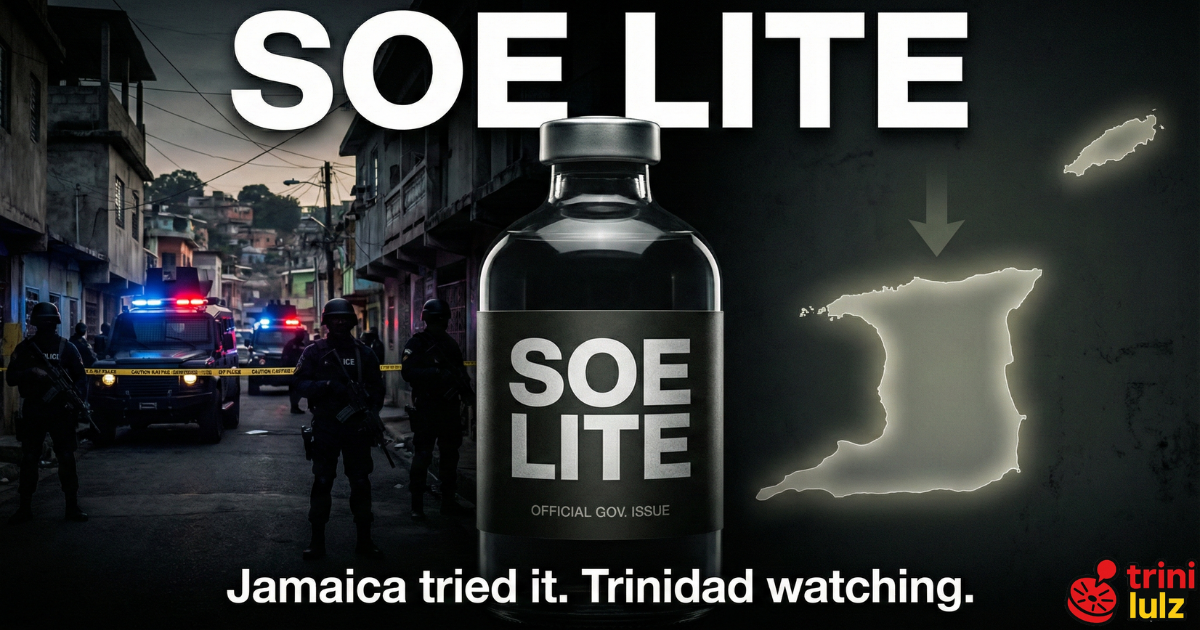
The phrase zones of special operations sounds like something out of a video game. Bonus powers. Restricted areas. Boss-level enemies.
In real life, it’s far less cinematic and far more political.
As Trinidad and Tobago prepares to introduce its own version, Jamaica stands as the Caribbean’s real-world test lab. The island has been running Zones of Special Operations, or ZOSOs, for years now, quietly turning selected communities into tightly controlled spaces where the state steps in hard, fast, and visibly.
The question Trinidad is about to answer is not whether Zones of Special Operations sounds good.
It’s whether SOE Lite actually delivers safety without quietly becoming SOE forever.
What actually are Zones of Special Operations
In Jamaica, a Zone of Special Operations is declared by the state in a defined geographic area with persistently high levels of violent crime. Once declared, the zone enters a three-stage doctrine borrowed from counterinsurgency playbooks.
For an official breakdown of how these Zones are meant to operate — including legal safeguards, community development requirements, and eligibility criteria for designation — you can read the Jamaican government’s summary of the Zones of Special Operations Act here: Jamaica Information Service – Zones of Special Operations fact sheet
Clear. Hold. Build.
“Clear” means a heavy joint presence of police and military moving into the area to disrupt gangs, seize weapons, and reassert state control. Residents quickly learn that movement, gatherings, and everyday routines are no longer entirely theirs to decide.
“Hold” is about maintaining that control. Checkpoints stay. Patrols intensify. Intelligence gathering ramps up. The zone does not relax just because the shooting slows.
“Build” is the promise. Social services, infrastructure upgrades, skills training, youth programmes, and community development are meant to follow the security push so that violence does not simply return once boots step back.
On paper, zones of special operations are not supposed to be permanent. They are targeted. Time-bound. Surgical.
Reality is messier.
“Zones of Special Operations isn’t just about crime. It’s about who controls space, movement, and daily life.”
Did it work in Jamaica?
Sometimes, yes. Consistently, no.
Early ZOSOs such as Mount Salem in Montego Bay were widely cited by Jamaican authorities as success stories. Murders and shootings dropped sharply after the declaration. Gang leaders were displaced. Weapons seizures increased. Residents reported feeling safer, at least in the short term.
Those gains mattered. Jamaica’s murder rate had reached levels that were economically and socially unsustainable. ZOSO created breathing room.
But not all zones followed the same script.
In places like Greenwich Town in Kingston, violence proved stubborn. Even with extended ZOSO status, murders fluctuated instead of collapsing. The state held the territory, but the underlying conditions that fuel violence did not evaporate.
This exposed the central tension: security is fast; development is slow.
You can flood a neighbourhood with uniforms in weeks. You cannot rebuild trust, livelihoods, and opportunity on the same timeline.
The quiet controversy nobody markets
ZOSO is often sold as smarter policing. Less blanket emergency powers. More precision. More humanity.
Yet for residents inside the zones, the lived experience can feel uncomfortably familiar.
Curfews, stop-and-search operations, restricted movement, and the constant presence of armed personnel blur the line between normal life and emergency rule. The legal framework may differ from a national State of Emergency, but the psychological impact often does not.
Critics in Jamaica have raised concerns about normalization. When zones are extended again and again, temporary measures begin to feel permanent. Communities start living under rules that others in the same country never experience.
And once emergency-style powers become routine in “problem” areas, the temptation to expand them grows.
CALL-OUT:
“A Zone that keeps getting extended isn’t special anymore. It’s just permanent emergency by another name.”
Why Trinidad is paying attention now
Trinidad’s government has been clear about its intent: move away from nationwide States of Emergency and toward targeted interventions. After months under extraordinary powers — including the recent decision to extend the State of Emergency — the shift is being framed as a smarter, more focused next step. Zones of special operations now offer a way to bottle the crime-suppression effect of an SOE without swallowing the political backlash of shutting down the entire country.
From a policy perspective, it makes sense. Crime is not evenly distributed. Hotspots exist. Why treat Diego Martin, Laventille, and Mayaro the same way?
But Jamaica’s experience sends a warning alongside the blueprint.
ZOSO works best when the “build” phase is real, visible, and fast. When it isn’t, the zone becomes little more than a heavily policed island of containment, keeping violence from spilling outward but never draining it at the source.
Trinidad’s history with “temporary” measures should make everyone cautious. Emergency tools have a habit of overstaying their welcome.
The question nobody can dodge
The uncomfortable truth is that zones of special operations force a trade-off.
You gain control.
You lose normalcy.
The gamble is that the loss is short-term and the gain becomes permanent. Jamaica’s mixed results show that this gamble only pays off when social investment keeps pace with security force momentum.
If Trinidad imports the name without importing the discipline, the funding, and the patience, ZOSO risks becoming what critics fear most: SOE Lite with the same bitter aftertaste.
“Security can clear a space. Only development can change it.”
Jamaica tested the model. The results are on the table. Trinidad is now reaching for the glass.
The real question is not whether it takes a sip.
It’s whether it knows when to stop.
Want the bigger picture? Explore our Trinidad Crime & Security hub for dashboards, explainers, updates, and deeper coverage of one of the country’s most urgent ongoing stories.