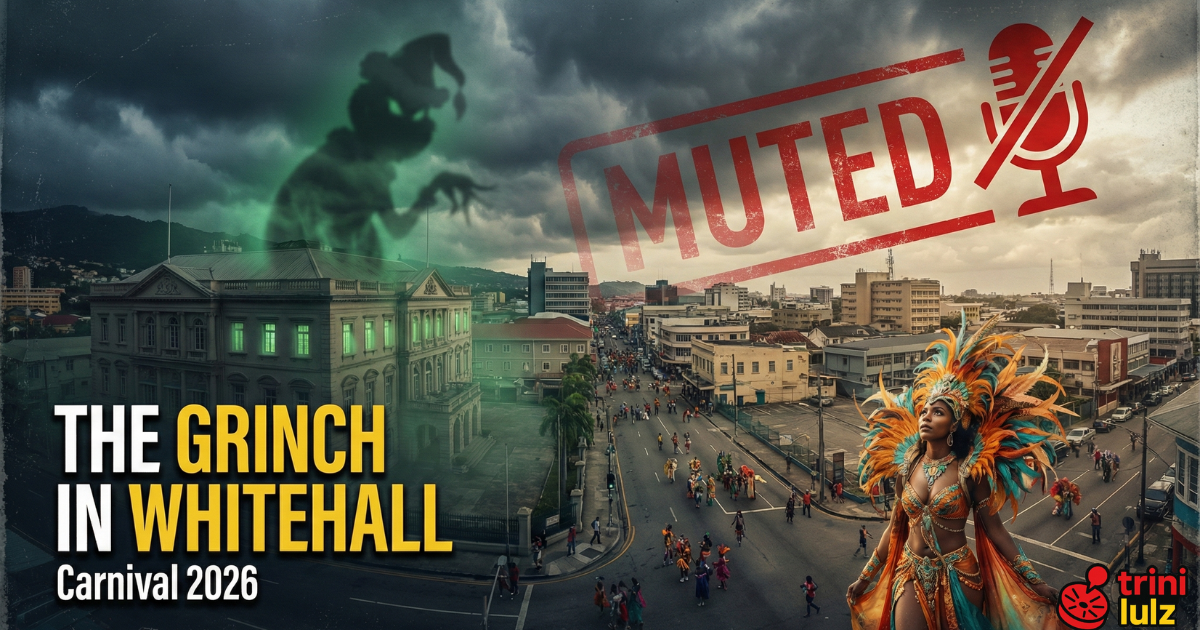
THE GRINCH IN WHITEHALL: How Carnival 2026 Got Gridlocked, Relocated, and “Muted” on Live TV
Carnival 2026 had feathers. It had paint. It had soca loud enough to wake the ancestors.
What it may not have had, according to growing public sentiment and multiple media reports, was the feeling of flow.
By the time the confetti settled, Carnival 2026 was being described in three words that should never sit together in a Trinbagonian sentence: gridlocked, relocated, and muted.
Nobody cancelled Carnival. There was no decree banning mas, no curfew on wining. Instead, what unfolded looked more administrative than authoritarian. More paperwork than police. Yet the cumulative effect felt cultural.
If there was a Grinch in Whitehall, it did not steal Christmas. It managed Carnival.
The First “Steal”: Moving the Party Before It Started
Long before Jouvert morning, the tone shifted.
Prime Minister Kamla Persad-Bissessar moved early in the season to block fetes at the Brian Lara Cricket Academy, citing concerns including noise and surrounding community issues. On paper, this reads like governance. In practice, it triggered a domino effect.
One of the largest Carnival events, Stink and Dutty, was forced to relocate to Chaguaramas.
Then came the traffic.
Reports described hours-long gridlock in and out of the peninsula. Some patrons reportedly sought alternative exits by sea. Businesses in the area complained of disruption severe enough to close operations. Carnival energy did not disappear. It stalled on the Western Main Road.
“Move the fetes. Break the roads. Then act surprised when the streets look thin.”
Carnival thrives on predictable chaos. This felt like engineered congestion.
Port of Spain: Bumper or Bare?
Officials pointed to numbers. Some National Carnival Commission events were reported as drawing strong crowds, including new free village initiatives. On paper, attendance sounded healthy.
But on the ground, a different story circulated.
Downtown vendors spoke publicly about a slower-than-expected start and softer sales compared to previous years. Carnival Monday at the Queen’s Park Savannah stage drew commentary from spectators asking, “Where are the bands?” as stretches of time passed with little mas crossing.
This does not prove Carnival 2026 was a failure. It suggests uneven distribution. Energy relocated. Spending concentrated differently. Movement disrupted.
Carnival is not just about attendance statistics. It is about density. It is about vibration. When streets feel thin, even if events elsewhere are packed, perception becomes reality.
And perception, in politics, is oxygen.
The Calypso Conscience: When Commentary Goes Quiet
Then came the deeper cultural tension.
After Calypso Fiesta, backlash erupted online and on radio over which songs advanced to the Dimanche Gras finals. Several social and political commentary calypsos did not make the cut. The Culture Ministry denied interference. Critics were unconvinced.
Calypso is not background music. It is the country arguing with itself in rhyme.
By Dimanche Gras night, Carnival 2026 delivered its most symbolic moment. During defending monarch Helon Francis’ performance, audio dropped on the state-run TTT broadcast. An apology followed. Explanations cited technical issues. The Prime Minister denied censorship.
We broke down that entire sequence in detail here: THE NIGHT THEY MUTED KAISO: Dimanche Gras 2026, Helon Francis, and the State-TV “Audio Cut” Nobody Believes.
Parallel livestreams reportedly experienced disruptions as well.
Technical failures happen. That is true. But timing is a cruel comedian. Guardian Media’s reporting on the incident captured the public skepticism and official responses in real time, noting both the audio disruption and the government’s denial of censorship.
“First the commentary misses the finals. Then the mic ‘fails.’”
In a nation where calypso historically challenges power, symbolism matters more than signal strength.
Carnival 2026: Managed, Not Missed
Carnival 2026 was not cancelled. The bands played. The paint sprayed. The fetes happened.
But something about the flow felt rerouted.
A major venue removed early. A mega-fete displaced into a traffic bottleneck. Complaints of thin stretches in Port of Spain. Vendors uneasy. Political calypso controversy. Then an audio cut during the climax of the season.
None of these alone “steals” Carnival. Together, they form a pattern of friction.
The Grinch in this story does not wear green fur. It wears administrative authority. It issues venue decisions. It manages logistics. It denies interference.
Carnival survives governments. It survived colonial bans. It survived oil crashes. It survived pandemics.
But Carnival also depends on trust. Trust that the roads will flow. Trust that venues are predictable. Trust that the calypsonian can sing without static.
Carnival 2026 leaves a question hanging in the humid air over Port of Spain:
When celebration starts feeling redirected instead of spontaneous, is that still Carnival, or is it something curated?
And in Trinidad and Tobago, curated joy rarely ages well.
This story is part of our wider Trinidad Politics Explained coverage. Explore the full hub for political analysis, key background, major controversies, and the latest updates.