Exxon Trinidad Is Scanning Our Deepwater. Is This Our Guyana Moment or Another Big Energy Gamble?
Trinidad and Tobago has spent years watching Guyana move from quiet neighbour to oil superstar. Every new floating production vessel, every billion-barrel headline, every international investor lining up in Georgetown has felt like a Caribbean energy drama playing out right next door while we sit here asking: what about us?
Now comes the big question.
Exxon Trinidad is scanning our ultra-deepwater.
And suddenly the conversation changes.
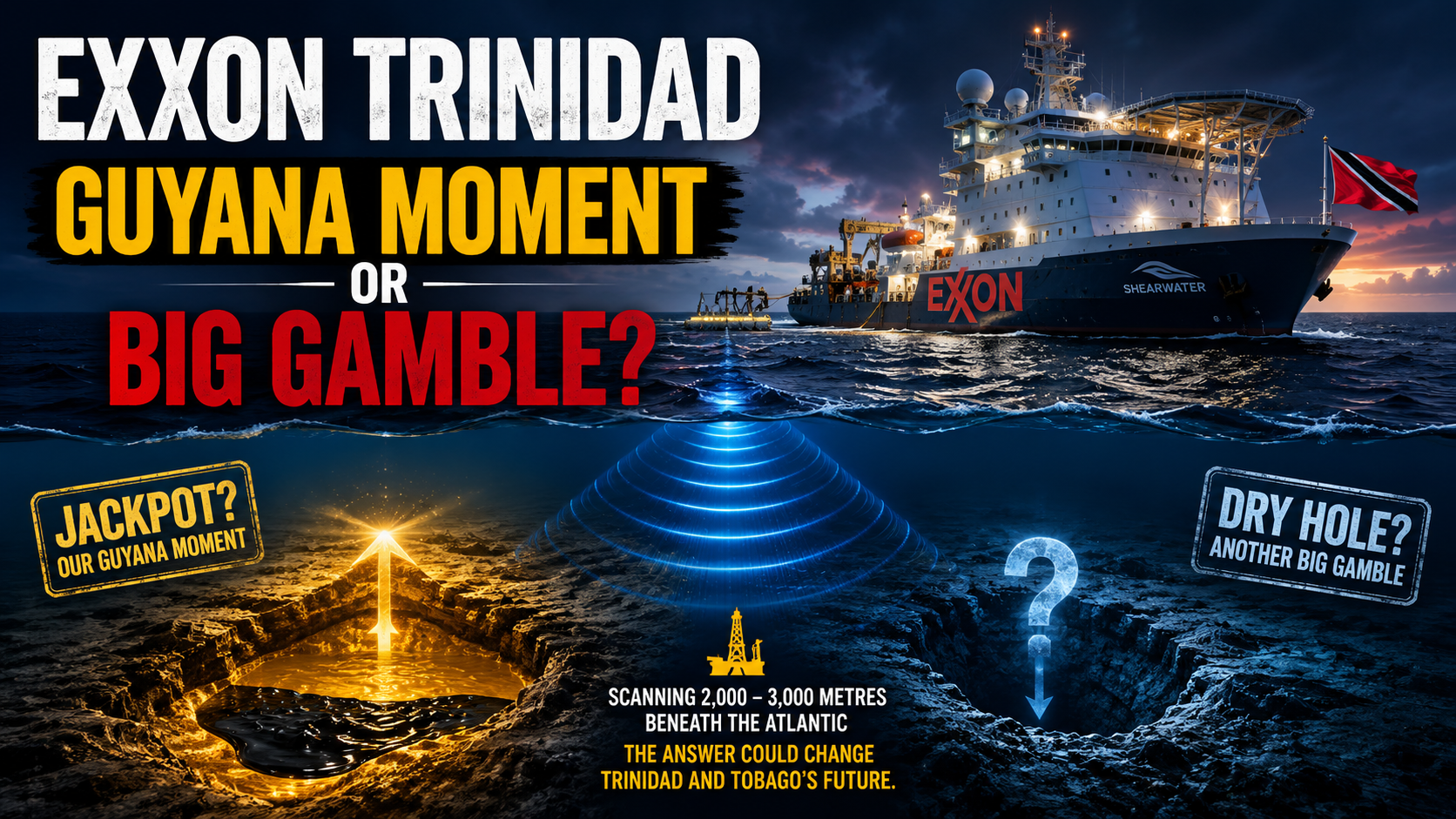
This is not a little boat passing by with some fancy equipment. ExxonMobil has awarded a contract to Shearwater Geoservices to acquire 3D seismic images over its large deepwater block offshore Trinidad and Tobago. Reuters reported that the work covers around 6,000 square kilometres and is expected to run for about five months in water depths of roughly 2,000 to 3,000 metres.
In plain Trini: Exxon is not dipping a toe in the water. Exxon is bringing out the deep-sea magnifying glass.
And what they are searching for could either become one of the most important energy stories in modern Trinidad history, or another reminder that the Atlantic does not reward wishful thinking.
Trinidad is not just hoping Exxon finds oil. Trinidad is hoping Exxon finds a future.
Exxon Trinidad and the Deepwater Question
The TTUD-1 block is one of the biggest energy plays Trinidad and Tobago has placed on the table in years. The Ministry of Energy announced that Trinidad and Tobago signed the Production Sharing Contract for TTUD-1 with ExxonMobil in August 2025, after seven ultra-deepwater blocks were consolidated into one area.
That alone should make people pay attention.
For decades, Trinidad and Tobago’s energy identity was built on oil, gas, LNG, petrochemicals and Point Lisas. We were not just “in energy.” We were the regional energy heavyweight. The country had the engineers, the infrastructure, the offshore history, the gas contracts, the industrial base and the reputation.
But times changed.
Gas shortages became part of the national vocabulary. Petrochemical plants started feeling pressure. Forex became tighter. LNG trains were not always running the way the public expected. And while Trinidad debated decline, Guyana became the shiny new oil story that every energy investor wanted to talk about.
So when Exxon returns to Trinidad’s ultra-deepwater, people are naturally going to ask the spicy question:
Are we late to our own blessing?
The Guyana Temptation
Let us be honest. The only reason this story hits so hard is because of Guyana.
In 2015, ExxonMobil announced the Liza-1 discovery offshore Guyana in the Stabroek Block. That discovery changed the country’s economic future almost overnight. ExxonMobil described Liza-1 as a significant oil discovery, with more than 295 feet of high-quality oil-bearing sandstone reservoirs.
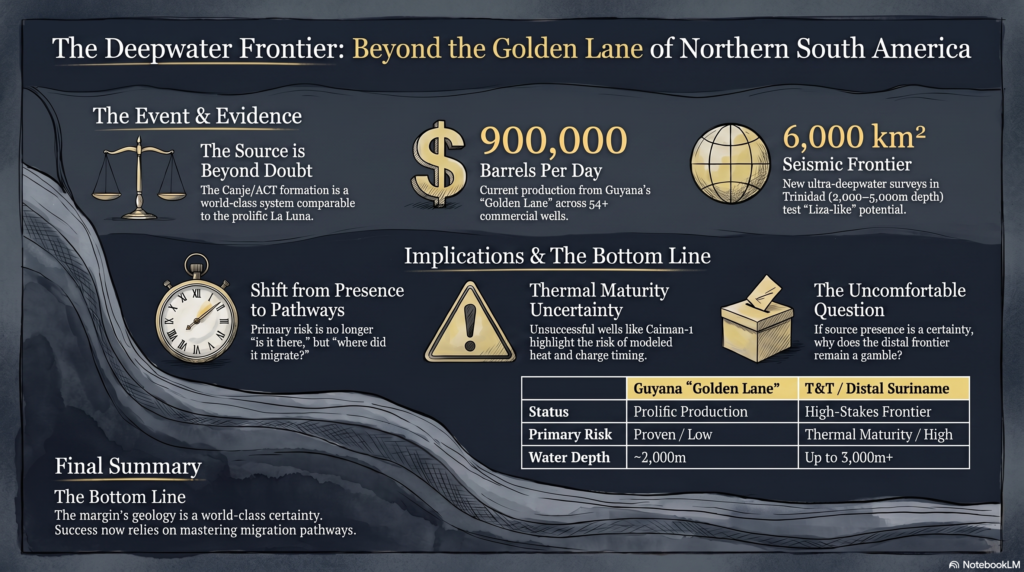
Since then, Guyana’s Stabroek Block has become one of the fastest-growing oil production zones in the world. Reuters reported in August 2025 that Exxon’s fourth floating production vessel in Guyana brought total production capacity from the block to more than 900,000 barrels of oil per day, with a target of 1.7 million barrels per day by 2030.
That is the kind of number that makes Caribbean governments sit up straight and fix their tie.
The approved petroleum research around the region refers to Guyana’s central play fairway as the “Golden Lane,” established by more than 54 commercial oil wells across 170 km of margin. That is not a lucky scratch card. That is a world-class petroleum system.
And naturally, Trinidadians want to know:
If Guyana had the Golden Lane, could Trinidad have the next lane?
Could our ultra-deepwater be part of the same big Atlantic story?
Could the geology that made Guyana rich be whispering under our side of the ocean too?
That is the hope. But hope is not hydrocarbons.
The Suriname Warning Nobody Should Ignore
Here is where the story gets interesting.
Being near Guyana does not automatically mean you become Guyana.
That is the lesson from Suriname.
The same broad regional conversation that makes people excited about Guyana also carries a warning. Recent exploration disappointments, including wells like Caiman-1 in Suriname, show that the Atlantic margin can be generous in one place and brutally unforgiving in another.
The approved technical analysis highlights what can be called the Suriname Paradox: Guyana’s Golden Lane has been enormously successful, but nearby areas have produced mixed or disappointing results. One major reason is that the subsurface changes. The margin changes. Heat flow changes. Crustal type changes. Source rock maturity changes.
In other words, oil does not care about our vibes.
You can be next door to a jackpot and still drill into a geological “not today.”
That is why Exxon’s Trinidad work matters. They are not simply asking, “Is there oil?” They are asking something far more complicated:
Did the source rocks form properly?
Were they buried deeply enough?
Did they heat at the right temperature?
Did the hydrocarbons migrate?
Did they get trapped?
Did the trap hold?
Did the system leak?
Did the timing line up?
That is the difference between a billion-barrel discovery and a very expensive PowerPoint presentation.
The Atlantic does not reward optimism. It rewards geology, timing, data and execution.
This Is Not Old-School Oil Hunting
The old image of oil exploration is somebody looking at a map, pointing offshore and saying, “Drill there.”
That is not what this is.
Modern ultra-deepwater exploration is a high-tech science project with billionaire consequences. The petroleum research now being used across Atlantic margins is moving away from basic regional mapping and toward full 3D modelling of the entire basin system.
That means scientists are trying to understand the whole deep structure of the earth, not just a pretty seismic line. They are modelling heat flow, crustal architecture, source rock maturity, migration pathways and charge risk.
The approved research behind this regional conversation makes one thing clear: traditional maturity indicators are not enough in ultra-deepwater settings. Variables like crustal type, ancient water depth and changing post-breakup heat flow can all affect whether the petroleum system worked.
Translated for the group chat:
You cannot just say, “Guyana have oil, so Trinidad must have oil too.”
The rock has to tell the truth.
And Exxon is paying to listen.
Why Exxon Trinidad Matters to Every Household
Some people will say, “That is oil company business. How does that affect me?”
Plenty.
Energy is not just something that happens offshore. In Trinidad and Tobago, energy affects government revenue, jobs, foreign exchange, industrial activity, construction, services, transport, small contractors, scholarships, subsidies, national budgets and the overall mood of the economy.
When the energy sector coughs, the whole country checks its temperature.
A major deepwater discovery would not solve every problem. Let us not get carried away. Guyana’s own oil boom has raised tough questions about inequality, contract terms, local benefits and whether ordinary citizens feel the wealth in their daily lives. But a serious discovery offshore Trinidad would still be a national turning point.
It could mean new investment.
It could mean new exploration confidence.
It could mean more international attention.
It could mean new jobs and services.
It could mean fresh revenue at a time when the country badly needs economic momentum.
Reuters previously reported that the TTUD-1 deal could lead to as much as US$21.7 billion in investment if commercially viable oil and gas discoveries are made.
That is not small change.
That is not “buy a next government SUV” money.
That is economy-shifting money, if the discovery is real, commercial and properly managed.
But We Have to Ask the Hard Questions Early
This is where Trinidad must not get drunk on the headline.
If Exxon finds something, the country must ask the right questions before the celebration truck starts circling the Savannah.
What are the contract terms?
What does Trinidad actually earn?
How much local content will be required?
Will our engineers, marine workers, fabricators, logistics firms and service companies benefit?
How will environmental risk be managed?
How transparent will the process be?
Will the country build long-term capacity, or just watch foreign companies make the serious money while we argue online?
Guyana’s experience shows that finding oil is only part of the story. Managing the oil is the real test.
And Trinidad has enough energy history to know better than to behave like a tourist in its own sector.
Finding oil is one thing. Making sure the country benefits is the real exam.
The Deepwater Gamble
The word “gamble” is not used here because Exxon is guessing blindly. Exxon does not move like a man buying Play Whe by the rum shop. These companies make decisions based on data, models, geology, risk and potential reward.
But ultra-deepwater exploration is still high risk.
The water is deep. The costs are huge. The geology is complex. The technology is advanced. The dry-hole risk is real.
That is why the current phase of Atlantic petroleum research is so focused on de-risking deepwater exploration. The goal is to move beyond simply asking whether source rocks are mature and toward predicting whether hydrocarbons were expelled, migrated, trapped and preserved at commercial scale.
That is the heart of the Trinidad question.
Not “Is there oil somewhere?”
But:
Is there enough oil or gas in the right place, at the right quality, under the right conditions, to justify development?
That is the difference between a national breakthrough and another offshore disappointment.
Is This Our Guyana Moment?
Maybe.
That is the honest answer.
There is a reason Exxon is here. There is a reason TTUD-1 matters. There is a reason seismic vessels are being deployed. There is a reason the region’s deepwater systems are being studied so intensely. There is a reason Guyana’s success has changed how companies look at the Atlantic margin.
But Trinidad should not confuse possibility with certainty.
Guyana’s story was not just “Exxon found oil.” It was the right reservoir, source, trap, charge, timing, water depth, commercial framework and execution lining up in a way that created one of the great offshore oil stories of the last decade.
Trinidad now has a chance to test whether its own ultra-deepwater has a similar story hiding beneath the Atlantic.
If the answer is yes, this country’s energy conversation changes.
If the answer is no, we will still have learned something valuable: that being close to Guyana is not the same as being Guyana.
Final Word
Exxon Trinidad is scanning our deepwater, and the country should be paying attention.
Not with blind excitement.
Not with political spin.
Not with “we rich again” madness.
But with serious national focus.
Because somewhere beyond the east coast, under thousands of metres of water and rock, there may be an answer Trinidad and Tobago has been waiting years to hear.
Are we standing at the edge of our next energy chapter?
Or are we chasing a billion-dollar dream through deep Atlantic uncertainty?
For now, Exxon is looking.
And the whole country should be watching.