SIX DAYS OF TERROR: HOW THE 1990 COUP ATTEMPT CHANGED TRINIDAD AND TOBAGO FOREVER
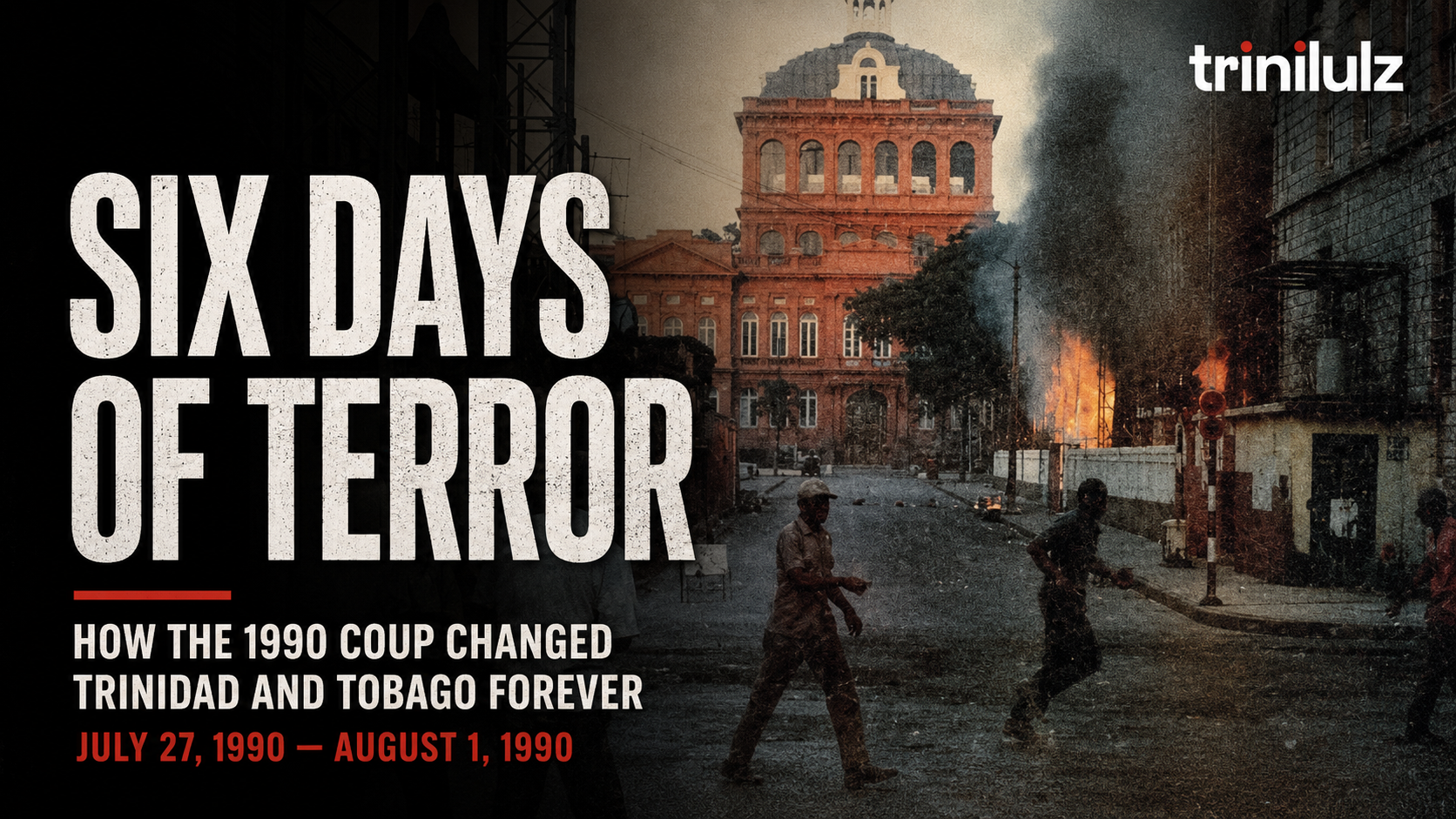
At approximately six o’clock on Friday, July 27, 1990, Trinidad and Tobago’s democracy became a hostage.
Armed members of the Jamaat al Muslimeen stormed the Red House while Parliament was in session. Prime Minister Arthur Napoleon Raymond Robinson, Cabinet ministers, parliamentarians and parliamentary employees were taken captive.
Almost simultaneously, another group seized Trinidad and Tobago Television, then the country’s only television station. Police Headquarters was attacked and set ablaze. Shortly afterwards, Jamaat leader Yasin Abu Bakr appeared on national television and announced that the elected Government had been overthrown.
For the next six days, Trinidad and Tobago existed in a terrifying space between constitutional government and armed coercion.
Gunfire echoed through the capital. Commercial Port of Spain was looted and burned. Families locked themselves inside their homes. Hostages wondered whether each passing hour would be their last. Twenty-four people were killed, more than 200 were injured, and countless others carried psychological wounds that never fully healed.
Thirty-six years later, the smoke has cleared from the Red House and the businesses have been rebuilt. But many of the questions raised by the 1990 Coup remain unanswered.
How did an armed organisation get close enough to seize Parliament and the national television station?
Why were intelligence warnings not converted into preventive action?
Why did parts of the capital descend into looting and fire?
And how did the men who attempted to overthrow the Government eventually walk free without a completed criminal trial?
The coup failed to remove the elected Government. But it succeeded in destroying something that could never be completely restored: Trinidad and Tobago’s belief that its democracy was untouchable.
The 1990 Coup failed to overthrow the State, but it overthrew the country’s sense of innocence.
The 1990 Coup did not begin on July 27
The assault did not appear without warning.
Its roots stretched through years of economic decline, institutional confrontation, social alienation and escalating conflict between the Jamaat al Muslimeen and the State.
Trinidad and Tobago entered the 1980s enriched by an oil boom. When energy revenues collapsed, the country was left with debt, unemployment, shrinking state resources and growing public frustration. By the latter half of the decade, austerity had become part of daily life.
The National Alliance for Reconstruction Government, elected in 1986 on a wave of optimism, inherited a deeply troubled economy. Its measures included reductions in expenditure, cuts affecting public-sector workers, removal or suspension of benefits and other policies that intensified resentment among citizens who already felt abandoned by the political system.
The economic crisis alone did not cause the attempted coup. However, it created the kind of environment in which radical messages could attract an audience.
People were unemployed. Communities felt neglected. Confidence in political institutions was declining. Accusations of corruption were widespread. The distance between the State and sections of the population appeared to be growing.
It was within this atmosphere that the Jamaat al Muslimeen expanded its influence.
The rise of the Jamaat al Muslimeen
Led by Yasin Abu Bakr, formerly known as Lennox Phillip, the Jamaat established itself as more than a religious organisation.
It offered discipline, belonging, food, shelter and a sense of purpose to some disadvantaged and alienated young men. It became known in certain communities for confronting drug dealers, intervening in neighbourhood disputes and assisting people who believed the formal institutions of the State had failed them.
At the same time, the organisation developed an increasingly confrontational relationship with the authorities and an armed, highly disciplined internal structure.
The Jamaat’s popularity among some marginalised Afro-Trinidadian youths gave it a social base. Its claims that the country was controlled by corrupt political and economic elites allowed Abu Bakr to present the organisation as both a religious movement and an alternative source of power.
The Jamaat al Muslimeen must not, however, be confused with Trinidad and Tobago’s wider Muslim community. Academic examinations of the organisation have distinguished it from the country’s established Muslim traditions and organisations. The actions of Abu Bakr and his followers were those of a particular radical group, not of Muslims generally.
The Mucurapo Road dispute
At the centre of the Jamaat’s conflict with the State was its compound at No. 1 Mucurapo Road.
The organisation occupied land that became the subject of a lengthy and complicated ownership dispute. Court orders, planning questions and demands that the Jamaat vacate or alter structures at the compound deepened the confrontation.
Abu Bakr refused to leave.
From the State’s perspective, the issue concerned occupation of public land and compliance with lawful court orders. From the Jamaat’s perspective, it became evidence that the Government intended to destroy the community it had built.
The conflict moved beyond ordinary litigation. Every court order, arrest and police operation was incorporated into a wider narrative of persecution.
That narrative was strengthened by the 1985 killing of senior Jamaat figure Abdul Kareem while he was in police custody. His death remained unresolved and became one of the organisation’s most powerful accusations against the authorities.
A major police raid on the Jamaat compound in 1988, during which weapons and ammunition were reportedly seized and members were arrested on a range of allegations, further hardened the group’s belief that a final confrontation with the State was approaching.
There may have been legitimate disputes over land, police conduct, poverty and unequal treatment. None of those grievances justified kidnapping elected officials, shooting hostages, attacking police facilities or attempting to overthrow a constitutional Government.
Understanding the causes of political violence is not the same as excusing it.
A country already cracking
By early 1990, the Government faced growing opposition from trade unions, political organisations and civil-society groups.
Public demonstrations reflected deep dissatisfaction with austerity and the condition of the economy. The Jamaat positioned itself within this wider atmosphere of resistance while preparing for something far more extreme than protest.
The organisation had accumulated weapons, studied strategic targets and developed a plan requiring separate groups to strike multiple institutions almost simultaneously.
Its intended targets were not random.
The Red House represented political authority.
Police Headquarters represented the coercive power of the State.
TTT represented control over information.
By capturing all three, the insurgents hoped to create the appearance that the Government had collapsed before the security services or public could understand what was happening.
It was an assault not only on buildings, but on the symbols through which a modern State governs.
The warnings that went nowhere
One of the most disturbing conclusions arising from the official Commission of Enquiry was that the 1990 Coup was not completely unforeseeable.
Intelligence had accumulated indicating that the Jamaat presented a serious security threat and that some form of insurrection was possible. The catastrophic failure occurred in how that intelligence was communicated, assessed and acted upon.
The Commission identified inadequate communication within the national-security system as a central cause of the State’s failure to prevent the attack. Information was underestimated, discounted or failed to reach officials capable of ordering effective precautions.
Security around Parliament was also dangerously inadequate.
The country’s elected leadership was gathered in one location with limited protection. Armed men were able to enter the parliamentary chamber, overwhelm resistance and take the Prime Minister and much of his Cabinet hostage.
The Government was not entirely blind.
It had pieces of the warning.
What it lacked was an effective system capable of assembling those pieces, recognising the threat and acting before the first explosion.
That may be the most important institutional lesson of July 27: intelligence has little value when the people receiving it are unwilling or unable to believe what it is telling them.
Day One: Democracy becomes a hostage
On the afternoon of July 27, Parliament was debating the Tesoro petroleum report.
Shortly before 6 pm, Police Headquarters was attacked. An explosion and subsequent fire created confusion within the capital while armed Jamaat members moved against the Red House and TTT.
Inside Parliament, gunmen stormed the chamber and announced that they were taking control. Prime Minister Robinson, government ministers, opposition parliamentarians and staff were detained.
At TTT, Abu Bakr and his followers took control of the station and its employees. At approximately 6.20 pm, he appeared on television and declared that the Government had been overthrown.
The broadcast was intended to create an immediate psychological victory. Anyone watching television could see the Jamaat leader speaking from the national station while the elected Government remained silent.
But the Government had not fallen.
The Defence Force remained loyal to the Constitution. Police and soldiers began securing strategic locations, surrounding the occupied buildings and preventing the insurrectionists from expanding their control.
The Jamaat had captured important institutions. It had not captured the State.
Robinson’s defining order
Inside the Red House, Prime Minister Robinson understood that the insurgents wanted him to order the security forces to stand down.
Instead, he issued the instruction that would define his response to the coup:
“Attack with full force.”
Robinson was beaten and shot in the leg.
The order was an act of extraordinary defiance. Had the Defence Force withdrawn, the Jamaat would have gained control of the streets surrounding the Red House and TTT, giving it greater freedom to consolidate its position or seize additional targets.
Robinson’s refusal denied the gunmen the legitimacy they were attempting to extract from him.
He remained a hostage, but he refused to become the instrument through which constitutional authority surrendered itself.
The six days at a glance
Friday, July 27: The assault
Police Headquarters was attacked and burned. Armed groups seized the Red House and TTT. Abu Bakr announced that the Government had been overthrown. Prime Minister Robinson ordered the security forces to attack and was subsequently beaten and shot. Looting and arson began spreading through commercial Port of Spain.
Saturday, July 28: The State responds
A State of Emergency and curfew were imposed. Soldiers and police secured strategic installations and isolated the insurgents at the Red House and TTT. The Defence Force took control of transmission infrastructure, preventing the Jamaat from continuing to use television as a propaganda platform.
Sunday, July 29: Negotiations and fear
Negotiations intensified through intermediaries. Planning Minister Winston Dookeran was permitted to leave the Red House to assist in discussions. Inside the occupied buildings, hostages faced deteriorating conditions, injuries and uncertainty over whether an agreement would be reached.
Monday, July 30: A capital under siege
Gunfire continued around the occupied sites. Curfews and military patrols transformed Port of Spain. Mediators moved between the sides while the legitimate Government continued operating from outside the captured Parliament.
Tuesday, July 31: The struggle over surrender
The wording and legal effect of proposed amnesty arrangements became central to negotiations. The insurgents sought guarantees against prosecution while hostages remained under threat.
Wednesday, August 1: Surrender
After six days, the Jamaat members surrendered and the remaining hostages were released. Abu Bakr and his followers were taken into custody. The siege was over, but the legal and constitutional controversy was only beginning.
Terror inside TTT
The national television station was not merely a communications target. It became a prison.
Journalists, technicians, camera operators and other employees were trapped with armed insurgents. Some initially hid in offices or technical rooms before being discovered. Others were forced into groups and held under threat.
Survivors later recalled shortages of food, reliance on water, recurring gunfire and the fear that the building could be attacked or destroyed with everyone still inside.
TTT operator Richard Purcell described hiding in a video room during the initial assault before being found. He later recalled the absence of food after the early stages of the siege and the nightmares that followed him after his release.
Journalist Gideon Hanoomansingh remembered the sound of gunfire, the threats made against hostages and the effort by senior journalist Jones P. Madeira to serve as a communications channel during negotiations.
Their experiences demonstrate why the events cannot be reduced to political strategy or legal debate.
Real people spent six days believing they might be killed because they had gone to work on an ordinary Friday.
Radio became a lifeline
With TTT under insurgent control, radio became essential.
NBS Radio 610 remained on air despite an attempted attack, providing news and reassurance to a population struggling to understand what was happening.
In an era before social media, smartphones, messaging apps and constant online updates, radio was often the only immediate connection between citizens and the outside world. Presenters had to communicate carefully, separating confirmed information from rumour while the crisis unfolded around them.
For many citizens, the voices coming through their radios were evidence that the country still possessed functioning institutions.
The battle over broadcasting during the 1990 Coup revealed a fundamental truth: during a national emergency, control of credible information can be almost as important as control of physical territory.
When Port of Spain burned
As the authorities concentrated on the Red House and TTT, sections of Port of Spain descended into chaos.
Businesses were looted. Buildings were set on fire. Goods were carried through the streets. The destruction extended the crisis beyond the hostage sites and inflicted enormous losses on merchants, employees and families whose livelihoods depended on the capital.
The looting did not necessarily represent public support for the coup. Much of it appeared opportunistic—a collapse of order exploited by people who recognised that the police and military were occupied with an unprecedented national emergency.
But the images were devastating.
The capital of Trinidad and Tobago was burning while its Prime Minister was being held at gunpoint.
For a country that had long considered itself politically stable, the sight was almost impossible to comprehend.
The people behind the casualty figure
Twenty-four people were killed during the attempted coup. More than 200 were injured.
Among the dead was Diego Martin Central MP Leo des Vignes, who was shot inside the Red House and later died from his injuries.
Other victims identified in official commemorations include members of the protective services such as Special Reserve Police officer Solomon McLeod, Assistant Superintendent of Police Roger George and Estate Constable Malcolm Basanta, as well as civilians including George Francis, Arthur Guiseppi, Helen Lavia, Lorraine Caballero and Mervyn Teague.
Yet even decades later, Trinidad and Tobago has struggled to produce and publicly centre a complete official roll of all those who died.
The number 24 is repeated every anniversary. The people represented by that number are too often forgotten.
Survivors also paid a price that cannot be measured by a casualty list. Some lived with gunshot injuries, chronic pain, nightmares, anxiety and memories of watching colleagues suffer.
Families waited through the siege without knowing whether their loved ones would return home.
Employees lost workplaces. Business owners lost everything they had built. Children learned that armed men could seize the country’s Parliament.
The trauma spread far beyond the Red House and TTT.
The amnesty that never brought peace
The surrender negotiations produced one of the most controversial legal episodes in Trinidad and Tobago’s history.
An amnesty or pardon was offered during the crisis as part of the effort to obtain the insurgents’ surrender and secure the hostages’ release. Acting President Emmanuel Carter executed the formal instrument.
After the Jamaat members surrendered, they were arrested and charged with offences including treason.
The Court of Appeal subsequently upheld the legal protection created by the amnesty and ordered their release. The Privy Council later ruled that the pardon was legally invalid, including because executive clemency could not properly excuse offences that had not yet been committed when the instrument was granted.
However, by then the men had been released and were not re-arrested for the coup.
Later Privy Council discussion of the case also stressed that, when the State formally grants what appears to be a pardon, it should be allowed to withdraw from that commitment only in extremely limited circumstances.
The result may be explainable through legal doctrine.
Emotionally, it was disastrous.
Twenty-four people were dead. Parliament had been seized. The Prime Minister had been shot. Businesses had been burned. Citizens had been terrorised.
Yet the country never received the full criminal trial and final judicial reckoning many expected.
The amnesty became a symbol of unfinished justice—a legal outcome that ended the prosecutions without resolving the national wound.
No victory without accountability
The Jamaat did not overthrow the Government.
The Constitution remained in force. The Defence Force did not defect. State institutions continued operating. The hostages were eventually released and the insurgents surrendered.
In that sense, democracy survived.
But survival should not be confused with victory.
A democratic State is not fully vindicated merely because it remains standing. It must also investigate its failures, account for the lives lost, compensate victims where appropriate, preserve the evidence and ensure that the same weaknesses cannot be exploited again.
For years, Trinidad and Tobago postponed that deeper reckoning.
The formal Commission of Enquiry was not established until approximately two decades after the attempted coup. Its final report was laid in Parliament in March 2014, almost 24 years after the attack.
By then, memories had faded, witnesses had died and evidence had become more difficult to reconstruct.
The delay itself became part of the national failure.
How the 1990 Coup permanently changed Trinidad and Tobago
Democracy lost its innocence
Before July 27, armed insurrection felt like something that happened elsewhere.
After July 27, no Trinidadian could honestly believe that constitutional government was beyond attack.
The Red House was no longer merely a historic building or seat of debate. It had been transformed into the scene of a hostage crisis, a shooting and an attempted overthrow of the State.
The country discovered that democracy was not self-enforcing. It depended on people and institutions being prepared to defend it.
National security could no longer rely on assumptions
The attempted coup exposed weaknesses in intelligence sharing, threat assessment, parliamentary security, crisis communications and coordination among state agencies.
These were not minor administrative deficiencies. They were failures that allowed armed men to capture the country’s political leadership.
National-security authorities have since said that protection around Parliament, officer training and intelligence capabilities have improved. In 2026, senior police leadership argued that the service is substantially better prepared to detect and prevent another comparable attack.
That reassurance matters—but the lesson of 1990 is that readiness must be tested rather than assumed.
Information became part of national defence
The seizure of TTT demonstrated how easily control of a national broadcaster could be used to manufacture the appearance of political authority.
Abu Bakr did not need to control the entire country to tell the country that he was in control.
The Defence Force’s decision to regain control of transmission facilities and the continued operation of Radio 610 prevented the Jamaat from dominating the national information space.
Modern communications technology makes it more difficult for a small group to seize every source of information. It also creates a new danger: rumours, manipulated recordings, false reports and propaganda can now spread nationally within seconds.
The central lesson remains the same. In a crisis, citizens need information that is fast, credible and independently verifiable.
The country’s relationship with armed non-state groups changed
The 1990 Coup proved that a relatively small but disciplined organisation could exploit social grievances, accumulate weapons and challenge the State.
It also demonstrated that community work, religious language or claims of political persecution could coexist with coercion and organised violence.
That is an uncomfortable lesson for any society confronting gangs or other organisations that combine neighbourhood influence with armed power.
Providing social assistance does not place a group above the law. Claiming to represent the abandoned does not create a right to terrorise the public. And the State cannot permit any organisation to develop a parallel system of armed authority.
Justice became inseparable from national trauma
The amnesty controversy permanently affected public confidence in the justice system.
For many citizens, it appeared that the most serious attack on the Republic had occurred without anyone being finally convicted for carrying it out.
The legal history was more complicated than that impression suggests. But public trust is shaped not only by technical correctness. It is also shaped by whether citizens believe the system has acknowledged the harm done to them.
The country received legal rulings.
It never truly received closure.
July 27 became a warning about emergency power
The attempted coup proved that governments require extraordinary capacity to respond to extraordinary threats.
It also proved why those powers must remain anchored to law.
Trinidad and Tobago is marking the 36th anniversary while again debating a State of Emergency, Preventive Detention Orders, intelligence powers and the balance between public safety and constitutional liberty.
The lesson of 1990 cannot be reduced to “give the State more power.” Nor can it be reduced to “the threat was exaggerated.”
The fuller lesson is that intelligence must be taken seriously, credible threats must be confronted early and security institutions must be capable of acting decisively. At the same time, emergency powers require evidence, oversight, accountability and respect for due process.
A State that ignores danger can place democracy at risk.
A State that abandons constitutional restraint in the name of danger can also place democracy at risk.
Why Trinidad and Tobago has never achieved closure
The Office of the President has repeatedly acknowledged that the country’s understanding of the coup remains incomplete and that victims, survivors and relatives continue to carry unresolved pain.
The Commission recommended that July 27 be treated as a day of national significance. Yet official commemoration has often lacked the scale, consistency and victim-centred focus appropriate for one of the darkest events in the nation’s history.
There is still no universally recognised public roll carrying the names and stories of every person killed.
There is no single national ritual through which the country collectively acknowledges the dead, the injured, the hostages, the protective services, the journalists, the mediators and the ordinary citizens who endured those six days.
Without remembrance, history becomes vulnerable to distortion.
Without accountability, grievance becomes mythology.
Without education, a new generation inherits the date but not its meaning.
The coup failed—but its warning remains
On August 1, 1990, the gunmen surrendered.
Trinidad and Tobago’s constitutional Government remained standing.
But the country that emerged from the siege was not the country that had entered it.
It had seen its Prime Minister shot.
It had watched its Parliament become a prison.
It had seen its national television station transformed into a weapon.
It had watched its capital burn.
It had learned that economic desperation could be exploited, that armed groups could grow behind narratives of social justice, that intelligence could fail inside bureaucratic silos and that legal agreements made during a crisis could haunt the country for generations.
The 1990 Coup therefore belongs to more than the past.
Its lessons are present whenever Trinidad and Tobago debates national security, gangs, surveillance, emergency powers, police intelligence, constitutional rights or the limits of executive authority.
The State must never again dismiss credible signs that an armed organisation is preparing to challenge the Republic.
But it must also never confuse national security with freedom from scrutiny.
Democracy is defended by strong institutions, not merely strong leaders. It is defended by reliable intelligence, professional security services, independent courts, a free press, accountable government and citizens who refuse to accept violence as a substitute for politics.
Thirty-six years later, remembering July 27 is not about reopening an old wound.
It is about ensuring that Trinidad and Tobago finally learns from it.
Because the most dangerous anniversary is not the one a country forgets to commemorate.
It is the one whose lessons it believes it has already mastered.
This story is part of our wider Trinidad Politics Explained coverage. Explore the full hub for political analysis, key background, major controversies, and the latest updates.