MORE POLICE. MORE SOEs. BUT TRINIDAD CRIME FIGHT MEANS STOPPING THE NEXT RECRUIT
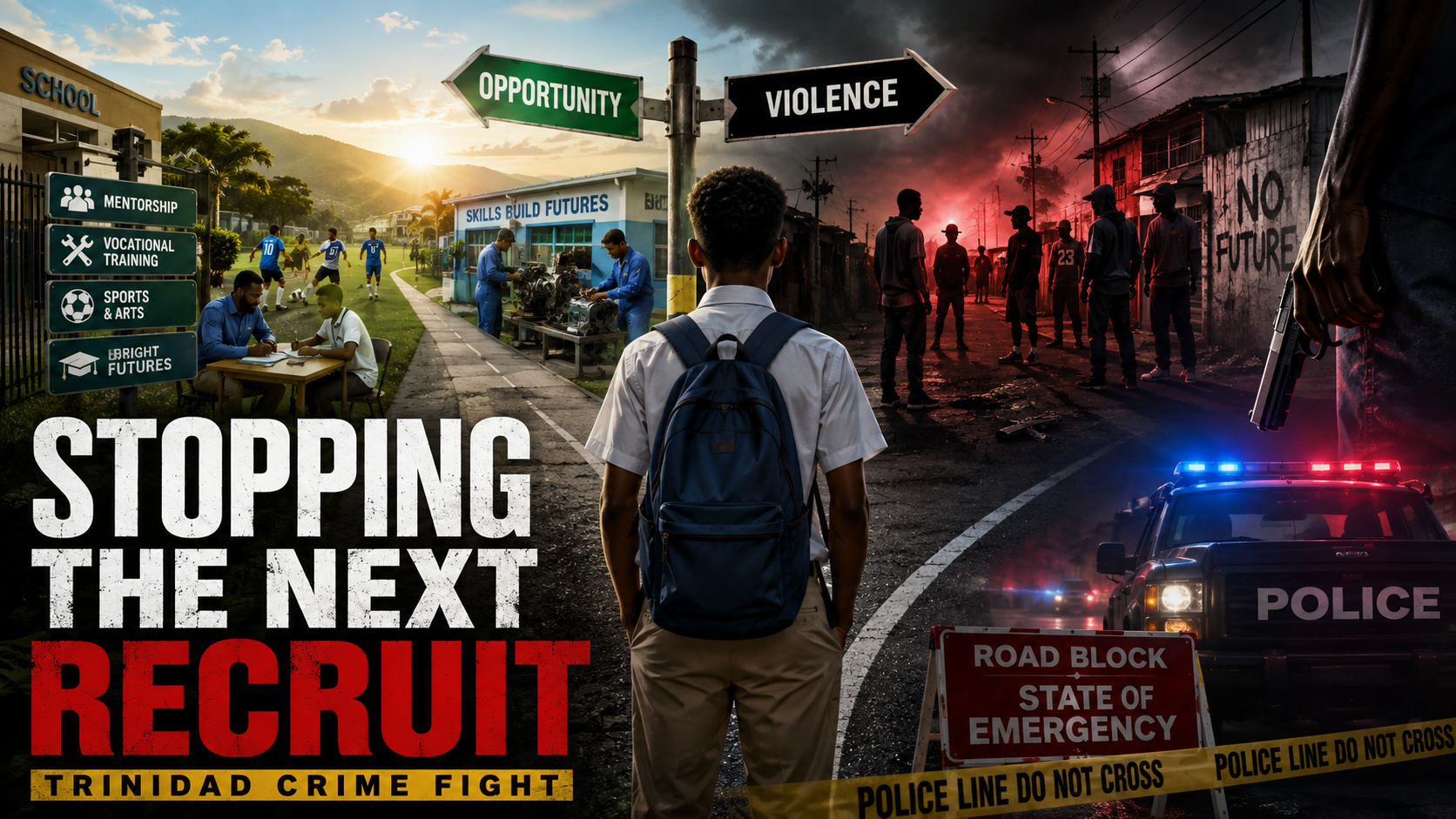
The murder count has fallen. Police have intensified operations. Trinidad and Tobago has spent much of the last two years under emergency powers. But a sustainable TRINIDAD CRIME FIGHT cannot begin when a young man already has a gun in his hand. It has to begin years earlier—at home, in school, in the community and wherever the next gang recruit is being made.
A police officer can stop a fight in a school corridor.
A State of Emergency can give law enforcement extraordinary powers to search, detain and disrupt criminal networks.
A patrol can recover a firearm before it is used.
An intelligence operation can put a suspected gang leader behind bars.
All of those things can be necessary.
But none of them, by themselves, answers the most important question in Trinidad and Tobago’s crime crisis:
Who is stopping the next recruit?
Because every gang member arrested leaves behind the possibility of a vacancy. Every gun seized can eventually be replaced by another gun. Every incarcerated shooter can be replaced by a teenager who has already learned that violence earns respect, gangs provide protection and the legitimate economy has little to offer him.
Police can arrest today’s recruit.
A serious TRINIDAD CRIME FIGHT must shrink the pool from which tomorrow’s recruit comes.
THE MURDER REDUCTION IS REAL—AND SHOULD NOT BE DISMISSED
Any serious examination of the UNC Government’s crime policy has to begin by acknowledging something its critics sometimes rush past.
Trinidad and Tobago recorded 369 murders in 2025, compared with 626 in 2024—a reduction of about 42 per cent and the country’s lowest annual murder toll since 2014. Police also reported reductions in serious and violent crime, increased detection rates, hundreds of illegal firearms seized and thousands of operations conducted during the year.
Those are real results.
It would therefore be intellectually dishonest to argue that intensified policing has accomplished nothing.
It would be equally dishonest, however, to pretend the murder reduction proves that Trinidad and Tobago has solved the underlying conditions feeding violent crime.
Attribution is also more complicated than simply drawing a line at the April 2025 election. The previous PNM administration had already declared a State of Emergency in December 2024, which continued until shortly before the change of government. The UNC subsequently declared another SoE in July 2025, which ended on January 31, 2026, only for another to be declared on March 3. Parliament extended that latest emergency again in June.
Trinidad and Tobago has therefore spent an extraordinary amount of time fighting crime under extraordinary powers.
The question is no longer whether those powers can disrupt crime.
The deeper question is what happens after the disruption.
TRINIDAD CRIME FIGHT HAS A PIPELINE PROBLEM
Crime does not normally begin with a murder.
There is often a long pipeline before the trigger is pulled.
A child grows up surrounded by dysfunction or violence. He struggles in school. He cannot regulate his emotions or resolve conflict. He becomes chronically absent. He falls behind academically. He is suspended. He disengages. There is little supervision at home. Legitimate employment looks increasingly remote. Someone older notices him. The gang offers belonging, money, protection or status.
Then, eventually, the police meet him.
But by the time the police officer is chasing that young man down a street, society may already have missed a dozen opportunities to change his trajectory.
That is why social workers are part of crime fighting.
So are guidance counsellors.
So are psychologists, teachers, mentors, coaches, remedial education programmes, apprenticeships, vocational training, family interventions and programmes that teach children how to manage anger and resolve disputes without violence.
These are not alternatives to policing.
They are what should happen before policing becomes necessary.
And this is where some of the choices made since the UNC returned to office deserve much greater scrutiny.
WHAT HAPPENED TO THE YOUTH OFF-RAMPS?
The Civilian Conservation Corps, MiLAT and MYPART matter in this discussion because of whom they were designed to reach.
The CCC explicitly targets socially marginalised young adults, including young people with limited qualifications and those at risk of entering the underground criminal economy. MiLAT was specifically designed as an intervention for at-risk young men, combining academics, discipline and behaviour modification.
In other words, these programmes operate at precisely the point in the pipeline where a young person can still be diverted.
Their history since 2025, however, requires some honesty.
The problems did not all begin with the UNC.
A CCC intake scheduled for January 14, 2025—months before the general election—had already failed to begin, leaving approximately 1,100 prospective trainees waiting. The review of the CCC had also originated under the former PNM administration.
That matters.
TriniLulz is not going to manufacture a cleaner political story than the facts allow.
But what happened after the change of government matters too.
CCC, MiLAT and MYPART were transferred to the Ministry of Defence and went through periods of uncertainty and restructuring. MiLAT was subsequently temporarily suspended in 2026 while Government reviewed its financial viability, affecting trainees and staff. Defence Minister Wayne Sturge insisted that the programme had not been permanently closed and said the Government was examining how it could be restructured.
And contrary to any suggestion that the Government simply erased all three programmes from the Budget, its own FY2026 estimates provided approximately $39.2 million for CCC, $16.9 million for MiLAT and $3 million for MYPART. The Ministry of Defence also officially lists the programmes among those under its responsibility.
So the legitimate criticism is not that the UNC took a red pen and abolished every youth programme on April 29, 2025.
The much harder question is this:
While programmes are being reviewed, transferred, suspended or restructured, what happens to the young people who needed them now?
A 17-year-old at risk of gang recruitment cannot pause his life while Cabinet restructures an intervention.
The gang is still recruiting.
AND THEN THERE ARE THE SCHOOLS
This may be the most important part of the entire debate.
Before the 2025 election, the Ministry of Education had introduced a Restorative Practices Initiative across 11 Schools of Focus. The programme sought to teach students and school communities how to resolve conflict, repair relationships and deal with misconduct without relying exclusively on punishment.
In February 2025, the Ministry reported that some participating schools had recorded reductions of more than 50 per cent in suspensions. A Peer Mediation Programme was also being developed to give students practical conflict-resolution skills.
That is not some fluffy education exercise disconnected from national security.
Teaching a 14-year-old how to walk away from disrespect instead of reaching for a weapon is crime prevention.
Teaching young people to de-escalate disputes is crime prevention.
Putting a trained professional in front of a traumatised child before a gang recruiter gets to him is crime prevention.
Former Education Minister Dr Nyan Gadsby-Dolly has now made serious allegations about what happened to that prevention infrastructure after the change of government.
In August 2026, Gadsby-Dolly warned about what she described as the “effective dismantling” of the Student Support Services Division. She alleged that non-renewal of contracts had contributed to shortages involving school social workers, counsellors, psychologists, diagnostic specialists, special-education personnel and restorative-practice practitioners. She also alleged that remedial education, mentorship and other interventions created under the previous administration had been discontinued or substantially weakened.
Those are Gadsby-Dolly’s allegations, and they should not be presented as independently established fact.
The Government has previously disputed the suggestion that restorative practices were simply abandoned.
In June 2025, the Ministry of Education said restorative justice remained active in schools where it had been implemented and that no decision had been taken to discontinue it. The Ministry said new security measures were intended to complement, rather than replace, restorative interventions.
That dispute now needs more than competing political statements.
It needs numbers.
POLICE IN SCHOOLS CAN DEAL WITH DANGER. THEY CANNOT DO EVERYBODY ELSE’S JOB.
The UNC Government made the deployment of specially trained police officers into high-risk schools one of its most visible responses to school violence.
Again, that is not inherently bad policy.
If a student walks into school carrying a firearm, call the police.
If a gang is threatening children, call the police.
If somebody is being assaulted, law enforcement has a role.
And the Government can point to encouraging early results.
By March 2026, Education Minister Dr Michael Dowlath reported that 95 specially trained officers had been deployed as part of the school programme. Government data showed reductions in suspensions and violent incidents at participating schools, while Dowlath described the broader strategy as including policing alongside counselling, psychosocial support and restorative practices.
That evidence matters.
But a police officer is not a psychologist.
A police officer is not a school social worker.
A police officer is not a remedial teacher.
A police officer cannot diagnose a learning disability, repair family dysfunction, provide months of trauma counselling or design an individual education intervention for a child who has been failing silently for years.
Putting police in schools may help manage the danger.
It cannot be allowed to replace the people whose job is to reduce the conditions producing that danger.
THE UNC’S OWN POLICY ACTUALLY AGREES
Here is where the debate becomes particularly interesting.
The UNC Government’s own official documents largely accept the central argument of this article.
The 2026 National School Code of Conduct explicitly says student-centred discipline should address the root causes of misbehaviour, while combining prevention, support and rehabilitation. It identifies Restorative Practices, Social-Emotional Learning and Positive Behavioural Interventions and Supports as part of the framework.
The Government’s Social Sector Investment Programme 2026 similarly calls for expanding Student Support Services and youth apprenticeships while investing in mediation, prevention, psychosocial interventions and safer communities.
So this is not really a philosophical argument between TriniLulz and the Government.
The Government’s own policy documents admit that policing alone is not enough.
Which makes the accountability question even more obvious:
Does what is happening on the ground match what Government says on paper?
How many school social workers are currently employed compared with April 2025?
How many psychologists?
How many guidance counsellors?
How many restorative-practice practitioners?
How many schools actually have functioning conflict-resolution programmes?
How many young people entered CCC, MiLAT and MYPART last year? How many completed? How many obtained qualifications? How many moved into employment?
How many high-risk teenagers received an intervention before a gang received them?
Those numbers should become as important to the national crime conversation as guns seized and people detained.
AN SOE CAN SUPPRESS VIOLENCE. IT CANNOT RAISE A CHILD.
The UNC has made aggressive enforcement a major part of its crime response.
Within its first 100 days, Defence Minister Sturge said the Government had implemented 12 of the 60 crime-fighting measures promised before the election. Its wider agenda has included security restructuring, additional personnel, police deployments, legislative changes, prison interventions and expanded enforcement activity.
The SoEs represent the most dramatic end of that philosophy.
And there are circumstances where a government confronting an imminent assassination plot, violent gang retaliation or an immediate threat to public safety may have little choice but to act forcefully.
But emergency powers are fundamentally suppression tools.
They can interrupt.
They can contain.
They can incapacitate.
They can buy time.
What they cannot do is raise a child.
They cannot give a teenager literacy skills.
They cannot provide a qualification.
They cannot repair a broken household.
They cannot provide the first legitimate job to a young man deciding whether the gang economy pays better than the real one.
They cannot teach a Form Three student that being embarrassed in front of his friends does not require violent retaliation.
They cannot make gang life less attractive unless something better exists on the other side.
That is the difference between fighting today’s criminal and preventing tomorrow’s one.
THE WARNING SIGNS HAVE NOT DISAPPEARED
The dramatic fall in murders during 2025 should be celebrated.
But it should not make Trinidad and Tobago complacent.
By July 2026, the murder numbers had begun moving much closer to the comparable 2025 trajectory. As of July 20, police figures put 2026 at 213 murders compared with 220 at the same point the year before. On June 30, both years had actually stood at 190.
In the same report, veteran criminologist and former police officer Clive Dottin raised an even more troubling issue: reports of children as young as 14 being recruited into gangs.
That should terrify policymakers more than almost any weekly murder count.
Because today’s 14-year-old recruit can become tomorrow’s gunman, next year’s murder victim or the prisoner taxpayers support for decades.
The most successful arrest is sometimes the arrest that never has to happen.
CARIBBEAN RESEARCH HAS ALREADY MOVED BEYOND “MORE POLICE”
This is not an argument for choosing social programmes instead of law enforcement.
It is an argument for understanding violence the way the evidence increasingly tells us to understand it.
In May 2026, CARICOM and the United Nations Development Programme launched a regional framework built around an important conclusion:
“Crime in the Caribbean can no longer be viewed solely through a law-enforcement lens.”
The framework treats crime simultaneously as a development, public-health and human-security challenge involving youth vulnerability, inequality, mental health, illegal firearms, organised crime and community conditions.
And Trinidad and Tobago already has its own evidence that prevention can produce results.
An Inter-American Development Bank evaluation of violence-interruption work in East Port of Spain found substantial reductions in violence in communities receiving targeted interventions. The IDB has also highlighted programmes combining behaviour change, community intervention, youth reintegration and focused law enforcement rather than depending upon arrests alone.
TriniLulz previously examined a similar philosophy through Baltimore’s focused violence-reduction model: concentrate policing intensely on the small number of people driving shootings, while simultaneously providing high-risk individuals with therapy, employment assistance, mentorship, housing support and a genuine route away from violence.
That is what holistic actually means.
Not being soft on criminals.
Being smart enough to know that prevention and enforcement do different jobs.
WE NEED A PREVENTION SCORECARD
Every week Trinidad and Tobago counts murders.
Police count firearms.
Government counts arrests.
During an SoE, authorities can count searches, detainees and operations.
Good.
Now count prevention with the same seriousness.
Government should publish, regularly and transparently, the number of Student Support Services professionals actually deployed; caseloads and waiting times; the number of schools receiving restorative-practice and conflict-resolution interventions; enrolment, completion and employment outcomes for CCC, MiLAT, MYPART and other youth programmes; apprenticeship placements; school dropout and chronic absenteeism indicators; youth recidivism; and measurable outcomes from interventions targeting the communities and families most vulnerable to gang recruitment.
Because if Government cannot tell the public whether the pool of recruitable young people is shrinking, then we are measuring the ambulance at the bottom of the hill while paying far less attention to the fence at the top.
STOPPING THE NEXT RECRUIT
The UNC Government is entitled to point to the dramatic decline in murders during 2025.
Police officers who removed guns from the streets deserve credit.
Officers who disrupted planned killings deserve credit.
If emergency measures prevented people from being murdered, those lives matter more than anyone’s partisan talking point.
But Trinidad and Tobago cannot declare victory every time the murder count falls and then return to the same social conditions that produced the killers.
A serious crime plan needs the police officer and the social worker.
The intelligence officer and the guidance counsellor.
The prison officer and the teacher.
The gun seizure and the apprenticeship.
The arrest tonight and the intervention that means there is one less person to arrest five years from now.
Because the ultimate measure of a TRINIDAD CRIME FIGHT should not simply be how efficiently we catch the young men who enter the crime pipeline.
It should be how many never enter it at all.
Crime fighting does not begin when somebody pulls a trigger.
By then, society may already have missed a dozen opportunities to intervene.
Police can arrest today’s gang member. Trinidad and Tobago now has to learn how to stop tomorrow’s recruit.
Want the bigger picture? Explore our Trinidad Crime & Security hub for dashboards, explainers, updates, and deeper coverage of one of the country’s most urgent ongoing stories.