T&T’s Cuba Embargo Vote: A Reversal of History—and Kamla’s Own Position
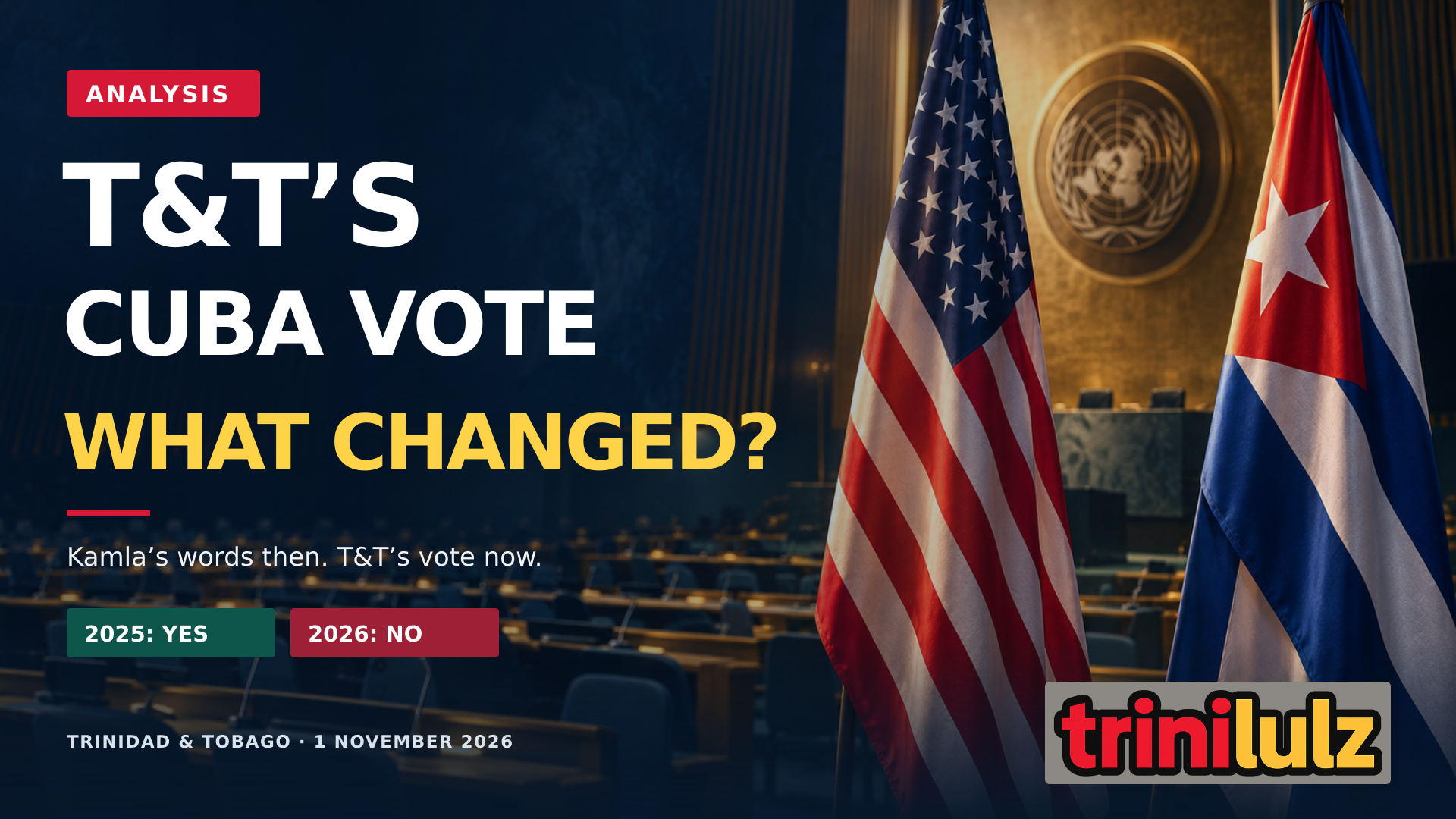
T&T voted with the US against the call to end Cuba’s embargo in 2026. The record shows years of support, Kamla’s explicit first-term opposition to the embargo—and a yes vote by her own government in 2025.
EXPLAINER & ANALYSIS · Updated 1 November 2026
T&T’s Cuba embargo vote in 2026 breaks with a position maintained across successive governments. By joining the United States against the UN call to end the embargo, Trinidad and Tobago also reversed the position Prime Minister Kamla Persad-Bissessar championed during her first administration—and the vote her returned government cast just one year ago.
On 28 October 2026, the General Assembly adopted the resolution by 130 votes to 17, with 25 abstentions. T&T voted no. The question was whether to support the UN’s call to end the American economic, commercial and financial embargo against Cuba. A no vote opposed that call; it did not create a Trinidad and Tobago embargo of its own.
The Government now presents its position as support for democratic change and the Cuban people. That explanation deserves to be reported. So does the documentary record showing that Persad-Bissessar previously regarded ending the embargo as part of the route to development, dialogue and Cuba’s fuller participation in the Americas.
T&T’s Cuba embargo vote: what the UN decided
The 2026 draft, A/81/L.5, continued a long-running General Assembly initiative against the embargo. UN News reported that this was the 34th such resolution and that the text again invoked sovereign equality, non-interference and freedom of international trade and navigation. It also challenged the reach of restrictions affecting third countries.
The resolution passed comfortably, but with substantially less support than in 2025, when the tally was 165 in favour, seven against and 12 abstentions. The change therefore extends beyond T&T. That broader shift does not erase the significance of this country moving from the yes column to the no column.
This is a General Assembly resolution, not a repeal of US legislation. Its immediate significance is diplomatic: it records governments’ positions and adds political pressure. It cannot, by itself, remove the embargo. Equally, a vote for ending the embargo is not a blanket endorsement of the Cuban government, its electoral arrangements or every aspect of its human-rights record.
T&T’s voting history: the long position before the reversal
The Guardian’s historical reconstruction identifies T&T’s 2026 vote as its first no since the resolutions began in 1992. T&T abstained in that first year, then supported the call to end the embargo at subsequent votes through 2025. UN records checked for this explainer corroborate the country’s support across several administrations, including Persad-Bissessar’s first term and the 2025 vote.
| Period or vote | T&T’s position | Why it matters |
|---|---|---|
| 24 November 1992 | Abstained | First annual General Assembly resolution; T&T’s abstention is identified in the Guardian’s historical account. |
| 1993–2025, at the votes held | Supported ending the embargo | A position maintained across successive governments; no annual vote was held in 2020. |
| 2010–2014 | Yes at all five votes | The annual votes that fell within Persad-Bissessar’s first premiership. |
| 27 October 2015 | Yes | This vote took place after Keith Rowley became prime minister. |
| 29 October 2025 | Yes | Persad-Bissessar had returned to office; UN resolution A/RES/80/4. |
| 28 October 2026 | No | T&T joined the United States in opposing the call to end the embargo. |
There is an important calendar qualification: there was no annual vote on this resolution in 2020, when the process was postponed during the COVID-19 pandemic. The next vote took place on 23 June 2021. Describing the history as a yes vote in every calendar year since 1993 would therefore be inaccurate.
The pattern matters more than a partisan scorecard. The anti-embargo position survived changes between PNM and UNC-led administrations. A government may change foreign policy, but a departure from that history calls for an explanation of the principle that has changed, the circumstances that prompted it and the outcome the new approach is intended to achieve.
How T&T voted during Kamla’s first premiership
Persad-Bissessar’s first premiership ran from 2010 to September 2015. Five annual embargo-resolution votes fell within that period, from 2010 through 2014. T&T supported the resolution at all five. The October 2015 vote belongs to a different administration: Keith Rowley had already become prime minister.
| Vote date | UN resolution | T&T vote |
|---|---|---|
| 26 October 2010 | A/RES/65/6 | Yes |
| 25 October 2011 | A/RES/66/6 | Yes |
| 13 November 2012 | A/RES/67/4 | Yes |
| 29 October 2013 | A/RES/68/8 | Yes |
| 28 October 2014 | A/RES/69/5 | Yes |
These are votes to support the call for ending the embargo, not votes to impose it. That distinction is easy to lose when discussion is reduced to whether T&T voted with Cuba or with America. The actual issue before the Assembly was the continued US embargo and its effects.
2011: a Port of Spain declaration calling for the embargo to end
During Persad-Bissessar’s first term, Port of Spain hosted the fourth CARICOM–Cuba summit. The declaration adopted on 8 December 2011 called for the immediate lifting of the embargo. It placed that demand within a wider relationship involving sovereignty, cooperation and the region’s ties with Cuba.
This was a collective declaration by the participating leaders, not a speech in which every sentence can be attributed personally to Persad-Bissessar. Nevertheless, it is evidence of the policy her government helped sustain as summit host. The position was expressed through regional diplomacy as well as UN roll calls.
2014: Kamla explicitly supported ending the embargo
In her UN General Assembly address on 26 September 2014, Persad-Bissessar explicitly supported “an end to the economic embargo against Cuba”. The full speech, preserved in reproductions of the UN General Debate text, linked that position to sustainable development and the international development agenda being negotiated at the time.
Her argument was that continuing economic restrictions against a developing country undermined shared development ambitions. This was more than a routine yes vote whose rationale must be guessed afterwards: she publicly supplied a development-based reason for the position.
The historical contrast should be stated precisely. The 2014 speech demonstrates opposition to the embargo. It does not establish that she approved of every action of the Cuban state, or that she was promising never to revise a policy. It does establish a clearly articulated earlier position against which today’s explanation can be assessed.
2015: her government welcomed normalisation and wanted the embargo lifted
In April 2015, as US–Cuba engagement gathered momentum, Persad-Bissessar welcomed the diplomatic opening. A statement published by CARICOM thanked President Barack Obama for “advancing Cuba’s return to the fold as a full partner in the Americas”. Contemporary Newsday reporting also recorded her enthusiasm for the Obama–Raúl Castro meeting and her support for ending the blockade.
That historical moment is useful because it complicates the idea that friendship with Washington necessarily requires support for the embargo. Persad-Bissessar was welcoming an American president’s engagement with Cuba. Cooperation with the United States and support for lifting restrictions appeared together in her government’s diplomacy.
An even clearer primary record is T&T’s submission dated 3 June 2015, reproduced in the UN Secretary-General’s report A/70/120. Her government opposed unilateral economic coercion and restrictions with extraterritorial effects. It connected its position to sovereignty, international trade, dialogue and the harm economic restrictions could cause to sustainable human development.
The submission welcomed US–Cuba dialogue and envisaged normalisation, “an integral part of which must be the lifting of the embargo”. This is a government document issued while she was prime minister, rather than a later recollection of what she once believed. Read T&T’s 2015 submission in the UN report.
It also referred to the diplomatic relationship established in 1972. That longer history explains why Cuba policy has been treated as a question of Caribbean independence and regional relationships, rather than solely an argument about the government in Havana.
The closest comparison is 2025: the same prime minister, a different vote
The most immediate comparison is not a decade old. On 29 October 2025, after Persad-Bissessar’s return to office, T&T voted yes on resolution A/RES/80/4. The UN’s recorded vote explicitly lists Trinidad and Tobago among the supporters. See the UN’s 2025 recorded vote.
That makes the 2026 decision a reversal within her present administration as well as a departure from the position taken during her first premiership. The question is therefore narrower and more concrete than whether the world has changed since 2014: what changed between T&T’s yes vote in October 2025 and its no vote in October 2026?
The records reviewed establish the difference in voting behaviour. They do not, by themselves, disclose the Cabinet’s deliberations, all communications with foreign governments or an assessment of the practical benefits expected from changing course.
What the Government says now
In defending the 2026 vote, Persad-Bissessar described Cuba as a “military dictatorship” and argued for political freedoms and democratic change. TTT’s 28 October report also recorded her support for US Secretary of State Marco Rubio’s position. Those are the Prime Minister’s stated political assessments and rationale.
Foreign and CARICOM Affairs Minister Sean Sobers expanded that explanation in the House of Representatives on 30 October. He said the vote was intended to support the Cuban people and their democratic rights. He also pointed back to the Prime Minister’s call for change at the February 2026 CARICOM leaders’ meeting in St Kitts and Nevis.
Sobers highlighted divisions across the region, including governments that opposed the resolution, abstained or did not vote. Those categories should not be collapsed into one position: abstention and absence are different from casting a no vote. Nor should regional disagreement be used to imply that every Caribbean government made the same choice.
The Government has therefore given a public explanation. The remaining issue is whether that explanation sufficiently connects its concern about Cuba’s political system to opposition to the particular UN call for ending the embargo. It is that connection—not the existence of a statement—that requires scrutiny.
Analysis: the policy question a slogan cannot settle
There are two distinct questions here. One concerns political rights in Cuba. The other concerns whether the US embargo is an effective, proportionate and defensible response. A government can advocate free elections and freedom of expression while also arguing that broad economic restrictions harm ordinary people or infringe other countries’ freedom to trade.
Persad-Bissessar’s earlier government took the latter position on the embargo. Her present government now uses the democracy argument to defend a vote against the call to end it. A complete explanation would address why the earlier concerns about development, coercion and extraterritorial restrictions no longer determine T&T’s vote.
It would also identify the mechanism by which the new position is expected to help Cubans. Is the aim additional diplomatic pressure, a different negotiating strategy, or alignment with a wider foreign-policy approach? What would count as progress, and what conditions would lead T&T to reconsider? These are questions for accountable policy, not evidence that a hidden arrangement exists.
Assessing the motives behind the change requires more than a roll call. The voting record documents the reversal; evaluating its diplomatic reasoning requires scrutiny of the Government’s explanations and the practical results of its policy. Evidence and stated reasons should remain distinguishable from political speculation.
The clearest conclusion is documentary: T&T’s 2026 no vote breaks with its long-established support for ending the embargo, with Persad-Bissessar’s explicit first-term position, and with her government’s own 2025 vote. Whether the new approach produces the democratic and humanitarian benefits the Government invokes remains a question to be tested against events.
This explainer reflects public records and reporting reviewed through 1 November 2026. Future official explanations, a published explanation of vote or a further policy announcement can be added here. The historical votes and dated statements should remain visible so readers can assess any new justification against the record.
This story is part of our wider Caribbean Geopolitics & Global Affairs coverage. Explore the full hub for regional security updates, diplomacy, migration, energy politics, and deeper analysis of how global power plays shape Caribbean realities.