CARTEL DE LOS SOLES: THE U.S. JUST CHANGED THE SCRIPT — AND TRINIDAD GOT PLAYED
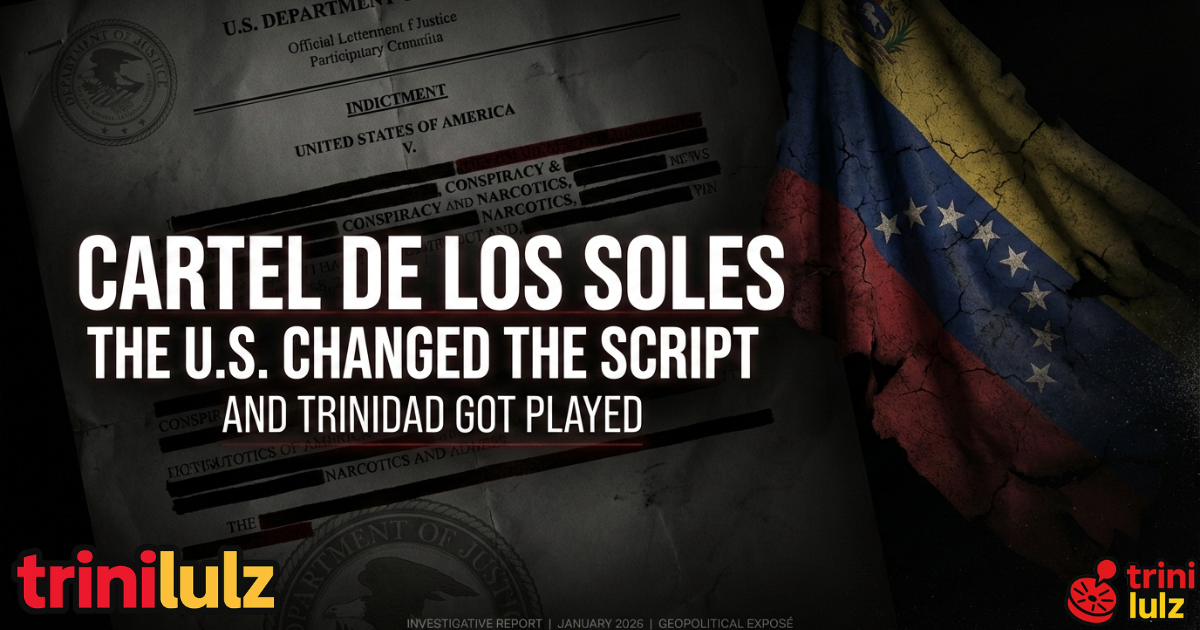
For years, Cartel de los Soles was treated like a settled fact, not a contested allegation.
It wasn’t just a phrase in a U.S. courtroom. It became a political password across the Caribbean. Say it loudly enough and you were “serious about security.” Question it and suddenly you were branded soft on drugs, soft on crime, or worse, sympathetic to traffickers.
In Trinidad and Tobago, that framing mattered. Support for U.S. action in Venezuela was sold locally as a moral imperative. The story was simple and convenient: Venezuela was run by a drug cartel in government clothing, and anyone who hesitated was defending narco-terrorists.
But here’s the problem.
The U.S. just quietly changed the script.
And nobody who spent years weaponising that label seems eager to explain why.
The Original Cartel de los Soles Claim
When U.S. prosecutors first unveiled charges against Nicolás Maduro and senior Venezuelan officials in 2020, they didn’t merely accuse them of corruption or facilitating drug trafficking.
They went further.
They explicitly described Cartel de los Soles as an actual, structured drug-trafficking organisation. According to the original indictments, it wasn’t a metaphor or nickname. It was presented as a coordinated cartel allegedly composed of high-ranking military and political figures, using state power to flood the U.S. with cocaine.
The narrative was cinematic. A rogue state. A uniformed cartel. A narco-regime.
That framing did serious work outside the courtroom. It collapsed nuance. It turned geopolitics into a morality play. And it gave regional governments, including Trinidad and Tobago, an easy justification for lining up behind Washington’s posture on Venezuela.
How That Narrative Was Used in Trinidad
In Trinidad and Tobago, support for U.S. pressure on Venezuela was framed not as a strategic choice, but as a test of character.
Government supporters pushed a blunt message:
If you oppose or even question U.S. action, you are effectively defending drug traffickers.
Foreign policy was reduced to a loyalty quiz.
Ask for evidence and you were accused of sympathy.
Ask for caution and you were painted as compromised.
This wasn’t abstract. It shaped public discourse, media framing, and political attacks. “Cartel de los Soles” became a rhetorical cudgel, not a legal claim open to scrutiny.
And that only worked because people believed the label was iron-clad.
Then the Indictment Changed
Fast-forward to the most recent superseding U.S. indictment tied to the Maduro case. According to reporting by Reuters, the updated charges focus on long-running corruption and drug-trafficking networks linked to Venezuelan officials, without centering the prosecution on a formally defined organisation called Cartel de los Soles.
Read it carefully.
You’ll still find serious allegations: decades of corruption, massive cocaine trafficking, collaboration with armed groups, criminal partnerships stretching across borders.
What you won’t find is the same central emphasis on Cartel de los Soles as a defined, standalone cartel entity.
The language shifts. The structure changes. The story becomes broader and more diffuse. Instead of anchoring the case to a named cartel allegedly embedded in the Venezuelan state, prosecutors focus on networks, relationships, and criminal conduct across time.
That may sound technical. It isn’t.
In legal storytelling, what you foreground matters. When prosecutors stop centering a label, it’s not accidental. It reflects strategy, evidentiary caution, and how confident they are in sustaining specific claims under pressure.
This doesn’t mean the U.S. suddenly believes Venezuela is innocent. As TriniLulz has already detailed, even the dramatic capture of Nicolás Maduro does not automatically dismantle the power structures that sustain his rule — the regime endures even when the figurehead falls. It means the story they are telling the court is no longer the same story they sold the public in 2020.
So What Changed — Evidence or Messaging?
Here’s where it gets uncomfortable.
The U.S. Treasury has separately designated Cartel de los Soles as a criminal organisation. That designation still exists. Sanctions remain. Political rhetoric remains.
But courtroom strategy is different from press-conference bravado.
Indictments are built to survive cross-examination, hostile judges, and defence teams paid to find weak joints in the narrative. When prosecutors streamline language, drop labels, or reframe accusations, it usually means one thing:
They are choosing the arguments they believe are most defensible.
That raises an obvious question.
If Cartel de los Soles was solid enough to function as the moral backbone of regional political arguments, why does it now fade into the background when the case actually matters most?
What Trinidad Was Never Allowed to Ask
This is the part nobody wants to revisit.
Trinidad and Tobago’s public debate was never allowed to sit with uncertainty. Citizens weren’t invited to weigh risks, regional consequences, or long-term instability. Instead, they were told the issue was settled, the villains were named, and dissent was suspect.
Now we learn that the foundational label used to shut down debate isn’t even central to the U.S. prosecution anymore.
That doesn’t make critics of U.S. policy heroes.
It doesn’t make Maduro a victim.
And it doesn’t turn Venezuela’s leadership into saints.
What it does expose is how easily imported narratives can be weaponised locally, and how quickly those narratives can change once they’ve done their political job.
The Real Lesson
This story isn’t about defending Venezuela’s government.
It’s about defending the public’s right to think.
When foreign policy becomes meme warfare, citizens stop asking serious questions. When labels replace evidence, debate becomes a loyalty test. And when the script quietly changes, the people who enforced it never circle back to explain themselves.
Cartel de los Soles may still exist as a claim.
But as a political bludgeon, its shine has worn off.
The next time a government tells you that disagreement equals criminal sympathy, remember this moment.
Because the indictment changed.
The rhetoric didn’t.
And Trinidad deserved better than both.