Caricom 50: Kamla’s “Dysfunctional” Rant and Trinidad’s New Foreign Policy—Performed in Front of Rubio
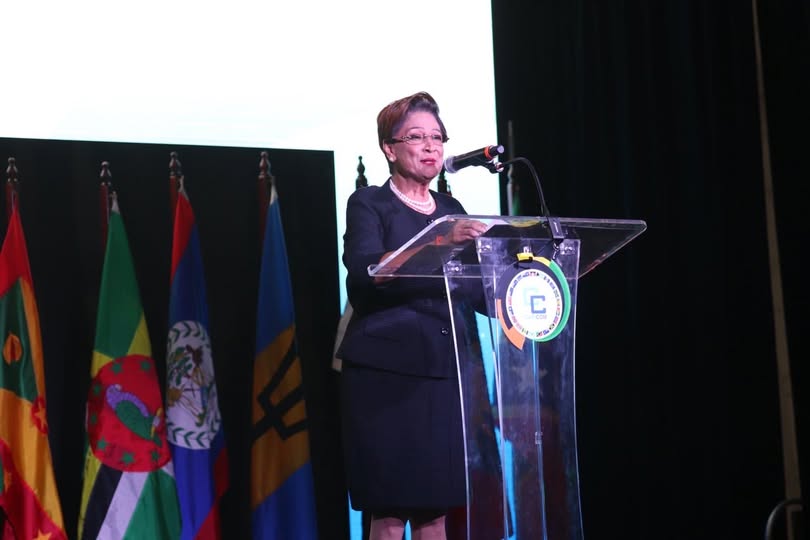
At Caricom 50, the 50th Regular Meeting of the Conference of Heads of Government in St. Kitts and Nevis, Prime Minister Kamla Persad-Bissessar did not come to clap politely and take the group photo. She came with a sledgehammer.
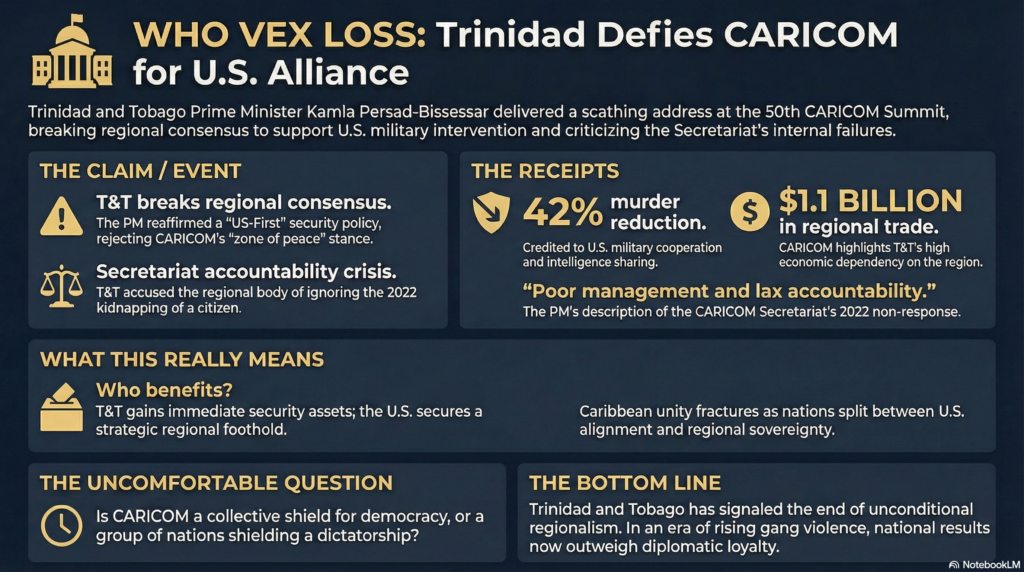
What was meant to be a high-level diplomatic summit marking over five decades of regional integration quickly turned into a headline-grabbing rebuke. In front of regional leaders and United States Secretary of State Marco Rubio, the Prime Minister described CARICOM as “dysfunctional” and “unreliable,” accusing it of poor management, lax accountability, and inappropriate political interference.
And just like that, Trinidad and Tobago’s foreign policy tone shifted in real time.
Caricom 50 Was a Summit. It Sounded Like a Break-Up.
Caricom 50 should have been about legacy. The Caribbean Community is the oldest surviving integration movement in the developing world. It gave us CXC. It built CARPHA. It created CDEMA. It established the Caribbean Court of Justice. Those are not small accomplishments.
Instead, the loudest sound from the room was public frustration.
Persad-Bissessar pointed to what she described as institutional failures, including the unresolved 2022 abduction of Trinidadian businessman Brent Thomas from Barbados. She framed CARICOM’s alleged silence as proof of structural decay.
Then she went further.
She dismissed the long-standing regional principle of maintaining the Caribbean as a “zone of peace” and openly signaled a willingness to embrace stronger U.S. military involvement in addressing Trinidad’s crime crisis.
In a region historically cautious about foreign military presence, that is not just rhetorical spice. That is policy.
“CARICOM 50 was a birthday party. Kamla brought divorce papers.”
The Rubio Factor: Optics Matter
Context is everything.
Marco Rubio’s presence at Caricom 50 was not ceremonial. Washington has sharpened its strategic focus on the Caribbean basin, citing narcotics interdiction, illegal migration, geopolitical alignment, and concerns over Cuba and China — priorities openly outlined in international coverage of the summit (see AP News report here.
So when Trinidad’s Prime Minister publicly undermines CARICOM’s credibility while simultaneously praising U.S. cooperation for a reported 42% decline in murders at home, the message travels beyond Basseterre.
It lands in Washington.
It signals a pivot: security first, consensus later.
CARICOM traditionally speaks with one voice on sensitive matters such as Cuba, Venezuela, and sovereignty. Persad-Bissessar’s remarks suggested Trinidad is prepared to prioritize bilateral alignment with the United States over regional diplomatic choreography.
That is a significant shift in posture.
It reframes Trinidad not as first among equals in CARICOM, but as a state prepared to freelance.
The Opposition Responds: “Reckless” and “Embarrassing”
The PNM opposition wasted no time responding. Opposition figures criticized the speech as inappropriate and diplomatically reckless, arguing that publicly branding the regional body dysfunctional damages Trinidad’s credibility and bargaining power.
Their argument is straightforward.
Trinidad and Tobago earns over US$1.1 billion annually from regional trade. CARICOM markets matter. Regional intelligence sharing matters. IMPACS cooperation matters. And when Prime Minister Gaston Browne publicly pushed back against Trinidad’s posture, it underscored how quickly regional friction can escalate. (Read our breakdown of that clash here: https://www.trinilulz.com/kamla-vs-gaston-browne-the-pride-behind-clash/)
Opposition voices framed the speech as political theater, suggesting that domestic law-and-order messaging was being projected onto a regional stage.
In other words: score local points, risk regional consequences.
The opposition’s deeper concern is that foreign policy is being recalibrated through confrontation rather than consultation.
That is not just tone. That is strategy.
Security Is Real. But So Is Sovereignty.
No one denies the crime crisis. Police commissioners estimate roughly 1.6 million illegal firearms circulating across the region. Transnational organized crime networks exploit porous borders. There are concerns about radicalized returnees from foreign conflict zones.
Security cooperation with the United States is not new. It is embedded in practice.
What is new is the framing.
Dismissing the “zone of peace” doctrine signals impatience with diplomatic orthodoxy. But it also opens a philosophical door. The Caribbean declared itself a zone of peace precisely to prevent great-power competition from destabilizing small states.
Inviting deeper U.S. security footprint while criticizing CARICOM cohesion risks replacing regional insulation with geopolitical exposure.
That tension was on full display at Caricom 50.
“When you call the family dysfunctional in public, do not be surprised if the family stops defending you in private.”
The Implementation Deficit Is Real. But So Is the Platform.
There is truth inside the frustration.
CARICOM does struggle with implementation. Agreements are signed. National execution lags. Variable geometry and competing memberships dilute unity. Sovereignty and community goals clash constantly.
But CARICOM is also the region’s main diplomatic shield.
When Guyana faces external pressure, CARICOM mobilizes. When hurricanes strike, CDEMA activates. During COVID, CARPHA coordinated health responses. These mechanisms are imperfect, not imaginary.
Publicly destabilizing the bloc during Caricom 50 sends a message of fragmentation at a moment when external actors are increasing pressure.
And optics, in diplomacy, are not cosmetic. They are currency.
A Foreign Policy Pivot in Real Time
The most important takeaway from Caricom 50 is not the headline quote. It is the trajectory.
Trinidad and Tobago appears to be recalibrating toward a more U.S.-centric security doctrine. That may resonate domestically. It may produce tactical gains. It may even yield measurable crime reduction.
But it shifts the balance between regional multilateralism and bilateral alignment.
That is not a minor adjustment. It is a philosophical repositioning.
And it happened in front of Rubio.
The question now is not whether CARICOM has flaws. It does. The question is whether publicly fracturing the bloc strengthens Trinidad’s hand or weakens the region’s collective leverage at a time of mounting geopolitical pressure.
Caricom 50 will be remembered not for celebration, but for confrontation.
And confrontation, once televised, has consequences.
This story is part of our wider Caribbean Geopolitics & Global Affairs coverage. Explore the full hub for regional security updates, diplomacy, migration, energy politics, and deeper analysis of how global power plays shape Caribbean realities.