Three Babies, One Broken Nation: The Children Trinidad Lost to Crime in 2026
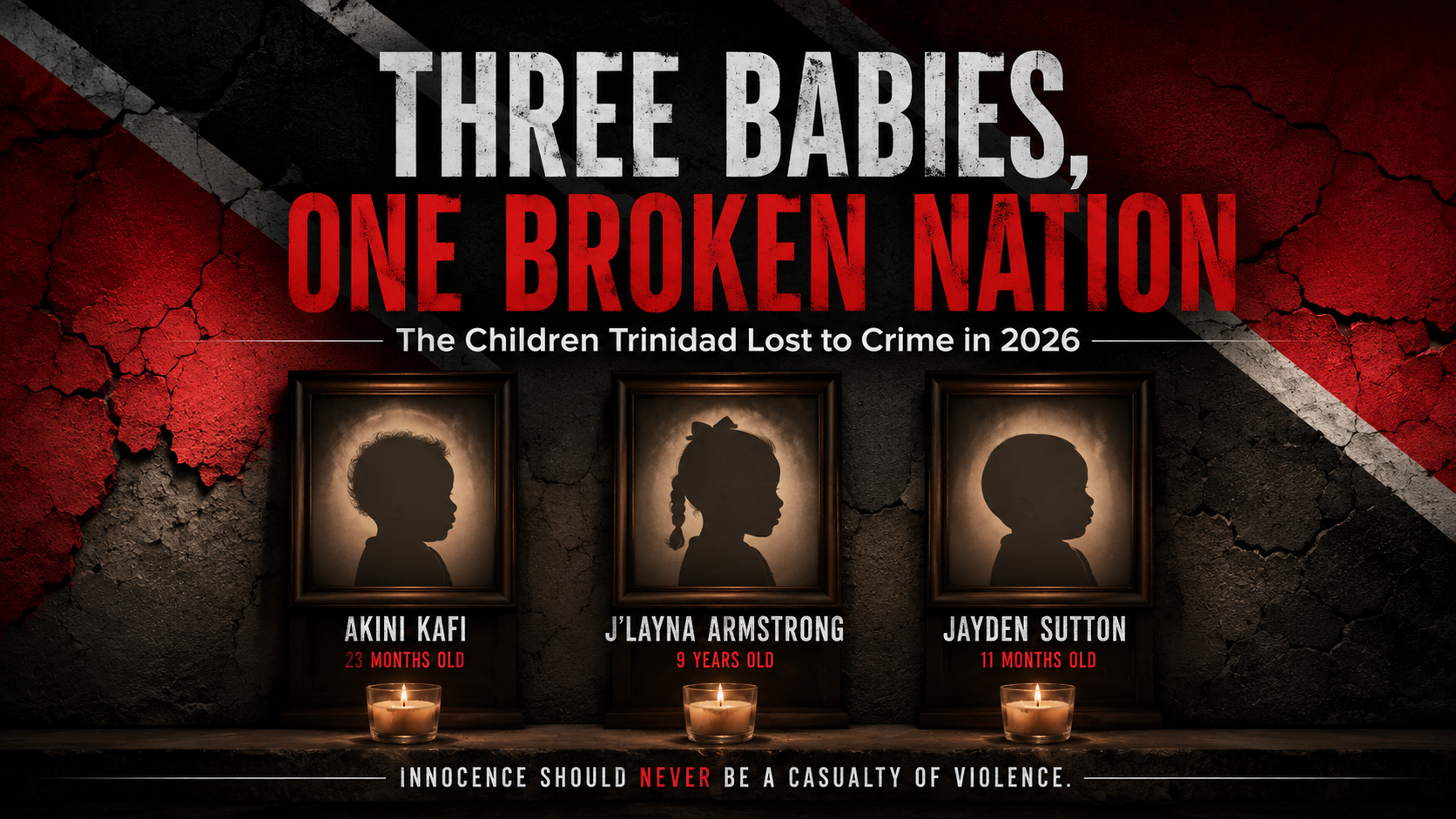
Trinidad and Tobago has reached the kind of moment no country should ever reach. We are no longer only counting murders. We are counting childhoods. We are counting daycare runs, family drives, bedrooms, and baby names that should never have appeared in a homicide report.
In 2026, three children have already become symbols of a national crisis that feels like it is eating its way into every ordinary corner of life.
Akini Kafi. J’Layna Armstrong. Jayden Sutton.
Three names. Three children. Three families shattered. One country forced to stare into the mirror and ask whether we are still shocked, or whether we have become dangerously numb.
Guardian Media reported that 23-month-old Akini Kafi was killed after gunmen intercepted a family vehicle in Belmont during what was described as a routine daycare run. His father, Akil Kafi, and Anthony Wilson were also killed, while Akini’s mother was hospitalised.
Nine-year-old J’Layna Armstrong was killed in a quadruple murder along Lady Young Road, Morvant, together with Asim Armstrong, Chelsea Edwards and Obateaiye Latiff. More than a week later, police had reported no arrests in that case.
Eleven-month-old Jayden Sutton and his father Joseph Sutton were killed after gunmen attacked their Dundonald Hill, St James home. TTT reported that both father and baby were taken to hospital, where they later died.
These are not just crime stories. These are warning signs written in the most painful language possible.
Children Trinidad Lost: The List No Country Should Have
There are lists that make a country proud.
Olympic medals. SEA scholarships. Carnival winners. Cricket records. Academic achievements. Young people making the nation smile.
Then there are lists like this.
A 23-month-old.
A nine-year-old.
An 11-month-old.
The children Trinidad lost in 2026 were not soldiers in anybody’s war. They were not policymakers. They were not gang leaders. They were not public officials responsible for state failure. They were children.
One was not even two years old.
One was still a baby.
One was a schoolgirl who should have been worrying about homework, friends, snacks, school events and childhood excitement, not becoming a national headline.
That is what makes this moment so heavy. The conversation cannot be reduced to “crime statistics” anymore. Statistics have become too cold for what the country is watching. A number does not tell you what it means for a family to lose a child. A graph does not capture a mother’s scream. A press release cannot carry the weight of a baby’s name.
“Trinidad and Tobago is no longer only counting murders. We are counting childhoods that never got a chance.”
And this is where the national conversation must change.
The Places That Should Have Been Safe
What makes these killings even more disturbing is not only who died, but where life was interrupted.
A family car.
A roadway.
A home.
These are not places that should require a crime plan to survive.
A child in a vehicle should be safe. A child at home should be safe. A child moving through the country with relatives should be safe. These are supposed to be the normal spaces of life. But in 2026 Trinidad and Tobago, even the ordinary now feels exposed.
Guardian’s report on the Belmont killing described the incident as happening during a routine trip to daycare. TTT reported that Akini, his father and a family friend were killed in the Belmont shooting, with police saying they would pursue those responsible.
That detail matters.
Because if a daycare run can become a death scene, what exactly is normal anymore?
If a baby sleeping at home can be killed, what exactly does “safe at home” mean?
If a child travelling with family can be gunned down, what kind of country are children inheriting?
This is not fearmongering. This is the reality families are now being forced to process. Parents are not only asking whether their children will pass exams, avoid bad company, or find good opportunities. Some are now quietly wondering whether they can move from point A to point B without being caught in somebody else’s violence.
That is a national emergency, even if nobody wants to call it that.
When Violence Stops Caring Who Is in the Way
Every society has crime. But not every society reaches the point where people begin to feel that innocence no longer offers any protection.
That is the frightening direction Trinidad and Tobago appears to be drifting toward.
Guardian Media reported that criminologist Dr Randy Seepersad warned the public must guard against becoming desensitised to repeated killings, after the Belmont killing raised concerns about rising violence and possible societal breakdown.
That word, desensitised, should trouble all of us.
Because once a country becomes numb, the criminals win twice.
First, they take lives.
Then they take the public’s ability to be horrified.
And when horror becomes routine, outrage becomes temporary. People post for a day. Politicians issue statements. Police promise action. The timeline moves on. Then another family gets the phone call. Another community grieves. Another candlelight vigil is held. Another child’s name enters the national record.
“A country that cannot keep babies safe cannot pretend its crime plan is working.”
This is the part where Trinidad and Tobago has to stop playing smart with the issue.
Crime is no longer just “those people in those areas.” Crime is no longer something that can be comfortably discussed from a distance. The country is too small for that kind of pretending. Belmont is not far. Morvant is not far. St James is not far. In Trinidad, nowhere is truly far.
When violence spills over, everybody eventually gets wet.
This is also why the national conversation cannot stop at outrage. As we explored in our previous article, “Why Is Trinidad and Tobago Crime So Hard to Fix? The Brutal Truth Nobody Wants to Say,” the crisis is not only about criminals pulling triggers. It is about broken institutions, weak enforcement, political blame games, community fear, social decay, and a justice system that too often moves slower than the violence itself. The deaths of Akini, J’Layna and Jayden are heartbreaking proof that Trinidad and Tobago’s crime problem is not just hard to fix. It is becoming impossible to ignore.
Where Is the Emergency Response for Children?
The question now is not whether crime is serious. That debate done dead.
The question is whether the country’s response matches the seriousness of what is happening.
After three children were killed in separate violent incidents in 2026, Trinidad and Tobago should not be having a normal political conversation. This should not be business as usual, with leaders trading blame like old Carnival costumes in a dusty box.
Where is the child-focused emergency response?
Where is the national plan for children living in communities where shootings are no longer rare?
Where is the urgent coordination between police, schools, social workers, community leaders, religious organisations, youth programmes and child protection agencies?
Where is the honest conversation about families trapped in areas where retaliation, silence, fear and distrust have replaced normal community life?
And where is the political maturity to say that dead children are bigger than party colours?
Because when a baby is killed, nobody should be asking whether the area is red, yellow, blue, green or any other colour. The only colour that should matter is the black cloth of national mourning.
This is not the moment for “well, under your government…” and “but when allyuh was in power…”
That talk may excite party groups, but it does nothing for grieving families.
Trinidad and Tobago needs less blame tennis and more action. Less microphone performance and more ground-level intervention. Less “we condemn this” and more “here is what changes tomorrow morning.”
Are We Still Shocked, or Just Scroll-Tired?
Social media has made tragedy faster. A killing happens. A post goes up. People react with angry faces, crying emojis and “smh.” Then the next scandal arrives. The next political bacchanal. The next viral clip. The next argument.
But the families do not get to scroll away.
They live with the empty room. The unused clothes. The birthday that will never come. The school bag. The toys. The silence.
That is why this article must not be treated as just another crime commentary. It is a pause button.
A forced pause.
A national “hold on, what are we becoming?”
Because if the deaths of Akini, J’Layna and Jayden do not shake Trinidad and Tobago, what will?
If three children killed in one year do not force a deeper response, then what number are we waiting on?
Four? Five? Ten?
And who wants to be the politician, police official, commentator or citizen who waits for the next child’s name before admitting the country is in trouble?
“Akini, J’Layna and Jayden are not statistics. They are the names Trinidad must not scroll past.”
Say Their Names
So let us say their names again.
Akini Kafi.
J’Layna Armstrong.
Jayden Sutton.
Not as hashtags.
Not as political ammunition.
Not as another entry in the murder count.
As children.
As lives.
As a warning.
As a demand.
As a reminder that a country does not only collapse when buildings fall or governments change. Sometimes a country collapses quietly, one normal day at a time, when people begin accepting the unacceptable.
A baby killed on a daycare run is unacceptable.
A child killed while travelling with family is unacceptable.
An infant killed at home is unacceptable.
And if Trinidad and Tobago still has a national conscience, then these three names must become more than a moment of grief. They must become a line in the road.
The line that says children are not collateral damage.
The line that says families cannot continue living like targets in their own communities.
The line that says speeches are not enough.
The line that says if we can mobilise for elections, Carnival, concerts, cricket, fetes and political rallies, then surely we can mobilise to protect children.
Because the true measure of a country is not how loudly its leaders talk when cameras are on.
It is how urgently the nation moves when its children are dying.
And in 2026, Trinidad and Tobago has already lost too much.
Want the bigger picture? Explore our Trinidad Crime & Security hub for dashboards, explainers, updates, and deeper coverage of one of the country’s most urgent ongoing stories.