
THE GOOD, THE BAD AND THE UGLY OF TRINIDAD INTERCEPTED COMMUNICATIONS MACHINE
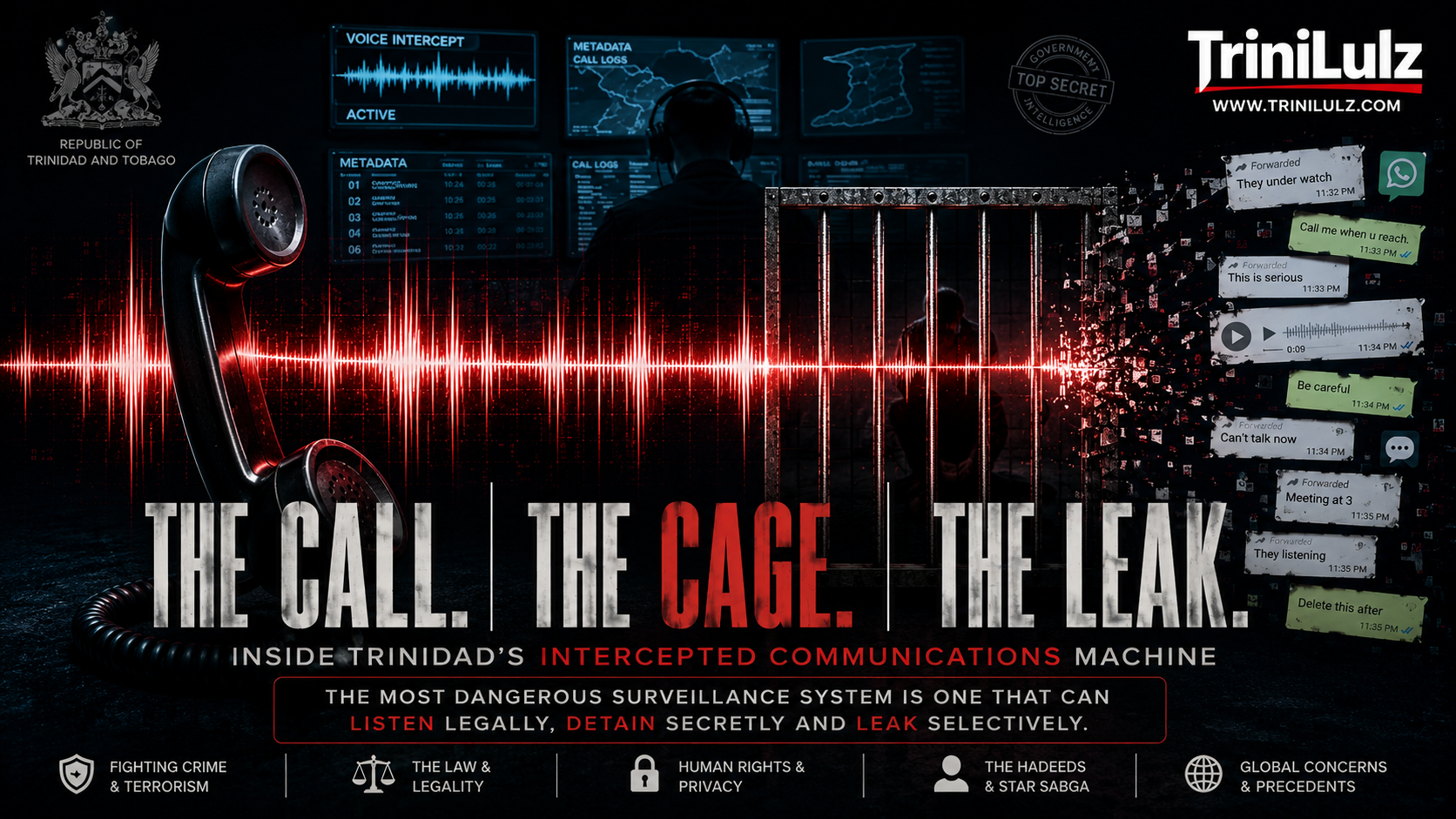
The call. The cage. The leak—and the surveillance system every citizen should understand
Imagine making a private telephone call.
You complain about the Government. You use colourful language. You say something reckless, angry or dramatic. You may be joking. You may be venting. You may mean every word—or none of it.
Unknown to you, the State may be listening.
Your words become intelligence. The intelligence is interpreted by security officials. It is placed before a minister or judge. It may eventually contribute to a search, an arrest, a Preventive Detention Order or months of investigation.
Then, before any criminal trial determines what those words actually meant, the purported recording appears on social media.
That is the frightening doorway through which Trinidad and Tobago has now entered the global debate over government surveillance.
The Trinidad intercepted communications controversy is no longer merely about whether Star Sabga said words attributed to her in a private conversation with her niece, Genevieve Hadeed. It is about something much larger: what the State can legally hear, who authorises it, how intelligence may be used to take away someone’s liberty and what happens when material that should be confidential begins circulating publicly.
It is the story of the call, the cage and the leak.
And whether you support the present Government, oppose it or have no interest in politics at all, it is a system every citizen should understand.
Editor’s note: This is a developing matter. Dominic and Genevieve Hadeed were released without charge on July 23, 2026. Star Sabga remained detained under a Preventive Detention Order as of July 26. The publicly circulated recording had not been independently authenticated, and no criminal charge based on it had been announced at the time of publication.
The conversation that opened the machine
Dominic and Genevieve Hadeed were detained at their home in late June under emergency powers amid allegations that they were connected to a conspiracy to assassinate Prime Minister Kamla Persad-Bissessar, the Attorney General and other members of the Government.
The couple denied the allegations and argued in court that their detention was politically and ethnically motivated. They were held for almost a month without being criminally charged before Homeland Security Minister Roger Alexander accepted a tribunal’s recommendation that their continued detention was not in the public interest. They were released on July 23, although their wider legal proceedings continued.
Star Sabga, Genevieve Hadeed’s aunt, remained detained.
Alexander subsequently filed an affidavit referring to intelligence material allegedly obtained from Sabga’s landline and Genevieve Hadeed’s mobile device. The State contends that statements contained in the material—including references to a bullet flying and the death of a government official—were relevant to an alleged wider assassination conspiracy.
A purported recording of a private conversation between the women then surfaced publicly.
According to Guardian reporting, the approximately 15-minute conversation included criticism of the Prime Minister and Government, politically charged comments and language that security officials reportedly interpreted as potentially corroborating the alleged plot. However, the recording’s authenticity had not been independently verified, its complete technical chain of custody had not been publicly established and Sabga had not been convicted—or even criminally charged—based on its contents.
That leaves Trinidad and Tobago confronting two separate questions:
Was the conversation evidence of a real threat?
And how did material described as confidential intelligence enter the public domain?
Both questions matter. Neither should be decided through WhatsApp forwards, political speeches or social-media verdicts.
First, stop calling everything Pegasus
One reason the public debate has become confused is that people frequently use “wiretap,” “phone search,” “interception” and “Pegasus” as though they describe the same technology.
They do not.
A traditional lawful interception generally captures communication as it passes through a telecommunications network. Depending on the warrant and system, authorities may obtain the content of calls or messages, along with communications data identifying who contacted whom, when, for how long and sometimes from where.
A device search is different. Police may physically seize a telephone or computer and seek authority to examine information already stored on it.
Spyware is different again.
Sophisticated spyware such as Pegasus may covertly compromise the telephone itself. Once a device is infected, it can potentially expose messages, contacts, photographs, location data, microphone access and other information before or after encryption protects a message in transit. The United Nations has warned that powerful spyware can effectively turn a smartphone into a round-the-clock surveillance device.
Therefore, the fact that Trinidad and Tobago possesses communications-interception technology does not prove that the country possesses Pegasus.
The existence of a recorded call does not prove that a telephone was hacked.
And nothing presently available in the public record establishes that Pegasus was used against Dominic Hadeed, Genevieve Hadeed or Star Sabga.
That distinction is not a technicality. It is the difference between verified information and a viral allegation.
How the Trinidad intercepted communications machine works
Trinidad and Tobago’s central surveillance law is the Interception of Communications Act, passed in 2010.
The law identifies the Chief of Defence Staff, Commissioner of Police and Director of the Strategic Services Agency as authorised officers. It creates a process through which an authorised officer may apply to a judge, without the intended target being present, for a warrant to intercept communications.
Before granting a warrant, the judge is supposed to consider whether the interception is necessary, whether it is likely to assist an investigation, whether less intrusive methods have failed or would be too dangerous or impractical, whether issuing the warrant is in the interests of justice and whether the anticipated benefit is proportionate to the intrusion.
That is the conventional safeguard: investigators do not merely say, “We want to listen.” They must convince a judicial officer that listening is justified.
But there is an important exception.
Section 6 of the Act permits an authorised officer to intercept communications without first obtaining a conventional warrant in circumstances connected to national security, preventing or detecting a serious offence, safeguarding the country’s economic well-being or providing international legal assistance.
Material obtained through that route may support a later warrant application, but the Act restricts its admissibility in criminal proceedings. The minister must also be informed within the statutory period.
The Act separately provides for urgent applications to a judge, including oral applications where circumstances do not permit the ordinary written process. These are still judicial warrants and must subsequently be regularised through documentation.
Ordinary interception warrants generally last for no more than 90 days, although renewals may be sought.
That means Trinidad and Tobago has more than one surveillance doorway. The public cannot responsibly evaluate the current controversy without knowing which doorway was used, what was authorised, whose communications were targeted and whether the information now circulating was obtained through the same operation described in court.
A law born out of a spying scandal
The genesis of Trinidad and Tobago’s interception law is one of the great ironies of this debate.
The legislation was not born during a period of public confidence in the intelligence services. It emerged after one of the country’s most disturbing surveillance scandals.
In November 2010, the Government disclosed that the former Security Intelligence Agency had allegedly monitored the communications of politicians, judges, journalists, trade unionists, entertainers and other prominent citizens without a proper legislative framework.
Reporters Without Borders identified several journalists whose communications had allegedly been monitored. Reports suggested that the surveillance operation had existed across successive administrations rather than being confined to one political party.
The Interception of Communications Act was enacted in December 2010 partly to move interception out of that legal darkness and establish rules for authorisation, retention, disclosure and parliamentary reporting.
But Parliament did something constitutionally significant.
The Act expressly states that it is intended to operate even where it is inconsistent with fundamental rights protected under sections 4 and 5 of the Constitution. It was therefore passed using the Constitution’s special-majority procedure.
Among those constitutional protections is the right to respect for private and family life.
That does not automatically make every interception unlawful. It means Parliament recognised that interception is an extraordinary invasion of protected rights and deliberately authorised it under specified conditions.
The Trinidad intercepted communications machine was therefore created to control a power that had reportedly been abused—but in controlling that power, the State also formally legalised it.
The system’s origin story was not technological.
It was a crisis of trust.
[Read TriniLulz’s complete timeline of the Hadeed detentions and emergency-powers battle.]
More than two million interceptions—but not two million people
Statutory reports reviewed by Guardian Media indicated that more than two million speech and data communications were intercepted across the available reports for 2018, 2019, 2020, 2021 and 2023.
That figure sounds staggering, but it requires context.
It does not necessarily mean two million people were deliberately targeted. One monitored person, device or investigation can generate thousands of calls, messages and data events.
In 2020, for example, 258,237 recorded interceptions reportedly related to 36 targets. The 2023 report recorded 192,748 intercepted communications connected to 18 targets. That year, the reports listed 16 arrests and five criminal proceedings in which intercepted material was used, but no conviction was recorded.
Separately, information obtained from the Judiciary showed that judges approved 314 interception warrants between 2020 and May 2026. Approvals peaked at 80 in 2021, while ten were approved between January and May 2026. Judges also refused nine applications in 2025, demonstrating that approval is not necessarily automatic.
A lack of reported convictions does not prove that every interception was useless. Intelligence may prevent a crime, identify a network, locate a person or guide investigators without becoming evidence in a completed prosecution.
But when a system intrudes so deeply into private life, the State must explain how success is measured.
It is also concerning that reports for 2022, 2024 and 2025 could not be located in Parliament’s public online archive, despite the law requiring annual reporting.
Secrecy may protect investigations. Missing oversight reports protect nobody.
THE GOOD
When listening can save lives
There are circumstances in which communications interception is not only defensible but potentially lifesaving.
A kidnapping victim may be moved before police can execute a physical search. Gang leaders may direct murders without ever touching a firearm. Trafficking networks may operate across several countries. A credible assassination plot may involve individuals whose public activities look completely lawful.
In these situations, conventional policing can be too slow, too visible or too dangerous.
A properly targeted intercept may help investigators identify accomplices, locate victims, understand the structure of an organisation, follow money, prevent an imminent attack or protect an undercover officer.
The law itself restricts interception to purposes such as national security, detecting serious crime, safeguarding the country’s economic well-being and assisting international investigations. Judicial warrant provisions require consideration of necessity, investigative value, alternative methods and proportionality.
A responsible government cannot simply abandon interception while organised criminals communicate through encrypted platforms, disposable devices and international networks.
The uncomfortable truth is that rejecting all surveillance would leave the State partially blind.
Citizens have a right to privacy.
They also have a right to life and security.
Any honest discussion must acknowledge both.
Why some surveillance must remain secret
There is also a legitimate reason interception operations are not debated publicly while they are taking place.
Informing a suspected criminal that authorities are monitoring a telephone would destroy the investigation. Revealing technical capabilities may allow gangs to change devices, communication channels and operational methods. Publicly identifying sources could get people killed.
Even after an operation ends, some information may remain sensitive because it reveals associates, foreign intelligence partners, undercover officers or unrelated private conversations.
The Act attempts to address this by limiting the number of people to whom intercepted information may be disclosed, requiring secure storage and mandating the destruction of irrelevant material or information that is no longer needed for anticipated proceedings.
Annual reports are supposed to provide aggregated accountability without publishing the details of live operations. They should tell Parliament how many warrants were sought, how many interceptions occurred, whether arrests or proceedings resulted and how the system was being used.
That is the balance a democratic surveillance regime should pursue: secrecy around legitimate operations, but transparency around the scale, performance and governance of the system.
The public does not need the name of every target.
It does need proof that the machinery is not listening simply because somebody powerful dislikes what a citizen is saying.
THE BAD
Legal does not automatically mean legitimate
A government can comply with the wording of a law and still raise serious human-rights concerns.
The Interception of Communications Act provides judicial safeguards, but it also contains broad grounds such as national security and the country’s economic well-being. Those phrases can cover genuine threats, but without disciplined interpretation they can become elastic enough to cover almost anything.
Applications are generally made without the proposed target being present. That is understandable operationally, but it means the judge hears only the State’s case when the warrant is initially considered.
The warrantless interception pathway creates an even sharper problem. An authorised official may begin surveillance under specified circumstances without first persuading an independent judge. Ministerial notification after the interception begins is not the same as independent approval before the intrusion occurs.
International human-rights standards do not say that surveillance can never occur. They say that an interference with privacy must be based on accessible and precise law, serve a legitimate purpose and pass tests of necessity and proportionality. It is not enough for surveillance to be merely helpful or convenient.
That produces a crucial distinction:
Lawful means officials complied with domestic authority.
Rights-compliant means the interference was also necessary, proportionate, independently supervised and accompanied by a meaningful remedy.
A democracy should demand both.
Words are not weapons until the evidence proves intent
The Sabga controversy demonstrates why intercepted speech can be dangerously difficult to interpret.
People frequently use violent metaphors without planning violence. Trinidadians speak dramatically. Political conversations become heated. Sarcasm, exaggeration, anger and macabre humour can sound entirely different when isolated from the relationship, tone and events surrounding a conversation.
That does not mean every violent statement is harmless.
A genuine threat should be investigated. A conversation coordinated with money, weapons, targets, surveillance or identifiable conspirators may become compelling evidence.
But phrases such as “when ah bullet fly” cannot safely interpret themselves.
Investigators and courts must consider whether the recording is authentic, whether the speakers are correctly identified, whether it is complete, what preceded and followed the statement, whether the words expressed intent, whether any overt action occurred and whether independent evidence corroborates the alleged conspiracy.
The danger becomes more severe when intelligence contributes to preventive detention.
Under ordinary criminal procedure, the State charges a person, presents evidence and permits that person to challenge it. Preventive detention reverses much of that sequence: liberty may be removed before a criminal charge and before the intelligence is tested through a public trial.
That may occasionally prevent catastrophe.
It can also convert an interpretation of somebody’s words into a prison cell.
Innocent people are always inside the surveillance net
An intercepted conversation rarely contains only the intended target.
It may capture a spouse, child, doctor, attorney, journalist, employee, business partner, political organiser or friend who has never been suspected of any offence.
Metadata can reveal relationships, routines and associations. Content may expose health conditions, financial problems, family disputes, commercial secrets, romantic relationships or confidential sources.
This is why minimisation and destruction rules matter.
The Act requires that disclosure and copying be limited to what is necessary. It also provides for the destruction of material unrelated to the interception’s objective and creates penalties for failures involving retention or disclosure.
But written safeguards are only as strong as the systems enforcing them.
Was every access to the Hadeed–Sabga material logged?
How many officials could retrieve it?
Were copies exported?
Was the circulated audio identical to the intelligence version?
Was it edited?
Did it come from a government system, a seized device, one of the participants or some entirely different source?
Until those questions are answered, nobody can responsibly declare where the recording originated.
The uncertainty itself exposes the vulnerability. Once the State collects private information, it assumes responsibility for protecting innocent people captured alongside the target.
THE UGLY
The leak may be more corrosive than the listening
The most dangerous part of this controversy may not ultimately be the interception.
It may be the apparent leak.
If the circulated recording is authentic and came from information obtained or held under the Interception of Communications Act, an unauthorised disclosure could itself raise serious legal issues. The Act creates offences concerning unlawful possession and disclosure, with penalties that can include imprisonment and substantial fines.
That does not mean any particular official, media organisation or political actor can presently be declared guilty. Investigators must first determine the source, authenticity and route of distribution.
But consider the institutional damage if confidential intelligence can be selectively released.
A leak can publicly humiliate an uncharged person. It can present one fragment of a larger conversation without the material that changes its meaning. It can prejudice future proceedings. It can expose intelligence techniques and make foreign partners reluctant to share sensitive information.
Most dangerously, it can transform surveillance from an investigative instrument into a political weapon.
Former police commissioner Gary Griffith has called for an independent investigation into whether the recording came from the SSA, who had access to it, who copied it and whether any official or political figure played a role in its distribution. He argued that the apparent breach may be a greater national-security threat than the contents of the conversation itself.
That question cannot credibly be settled by the same people whose conduct may need to be examined.
Selective surveillance can become selective justice
Dominic and Genevieve Hadeed have alleged that their detention represented political retaliation and discrimination against members of Trinidad and Tobago’s Syrian-Lebanese community perceived to support the Opposition.
Those allegations have not been established as fact.
They must nevertheless be taken seriously because surveillance operates in secret, while minorities and political dissidents have historically borne disproportionate risks when secret powers are abused.
The global Pegasus experience shows the pattern. Journalists, lawyers, human-rights defenders, opposition figures, protesters and civil-society organisers have repeatedly appeared among reported targets of sophisticated spyware. Citizen Lab investigations have documented Pegasus infections involving journalists and a human-rights defender in Mexico, as well as pro-democracy activists, academics, lawyers and NGO workers in Thailand.
The European Parliament concluded that spyware had been abused to intimidate political opposition, silence critical media and interfere with democratic processes.
Trinidad and Tobago already carries the memory of a surveillance agency allegedly monitoring journalists, judges, politicians and trade unionists.
That history makes public suspicion predictable.
When the State uses extraordinary powers against prominent government critics, it must provide stronger—not weaker—assurances that ethnicity, political affiliation, wealth, criticism and personal relationships were not substituted for evidence.
Who watches the watchers?
The surveillance system is supposed to contain several layers of protection: judicial warrants, ministerial notification, secure handling, destruction requirements, criminal penalties and annual reports to Parliament.
Yet gaps remain.
Some interception may begin without prior judicial authorisation. The target may never learn that surveillance occurred. Information is held inside institutions whose operational secrecy makes external scrutiny difficult. Parliamentary reports have not always appeared promptly in publicly accessible archives.
And now a purported confidential conversation connected to an ongoing national-security controversy is circulating online.
The solution is not to publish every intercept or expose every active investigation.
It is to build independent oversight capable of examining the entire chain without compromising operations.
That should include:
- tamper-resistant access logs showing everyone who viewed, copied or exported intercepted material;
- independent technical audits of interception systems;
- prompt annual reports containing meaningful performance data;
- stronger parliamentary review conducted under confidentiality rules;
- procedures for protecting attorney-client and journalistic communications;
- independent investigation of suspected misuse or leaks;
- eventual notification to surveillance targets where doing so would no longer endanger an investigation;
- compensation and legal remedies where interception was unlawful or recklessly mishandled.
The question is not whether security officials should be trusted.
The purpose of oversight is to ensure that no democracy depends entirely on trust.
The Gary Griffith and Pegasus file
The Trinidad Pegasus story contains confirmed facts, contested claims and a considerable amount of political fog.
Here is what can responsibly be said.
CONFIRMED: An interception-of-communications solution was procured during Gary Griffith’s tenure as Commissioner of Police between 2018 and 2021.
DISPUTED: Former prime minister Keith Rowley said the procurement had not been authorised by the National Security Council for use by the Police Service and that the equipment was transferred to the SSA. Griffith disputed the suggestion that he acted secretly and maintained that relevant national-security officials knew about the acquisition.
DENIED: Rowley publicly denied that the State possessed or used Pegasus. Griffith also said the Police Service did not purchase Pegasus or other spyware directly from Israel and stated that Trinidad and Tobago did not have Pegasus.
UNPROVEN: There is no reliable public evidence presently establishing that Pegasus was deployed in Trinidad and Tobago, identifying a citizen whose device was forensically confirmed as infected by a State-operated Pegasus system, or connecting Pegasus to the Hadeed–Sabga investigation.
The procurement controversy still matters.
It raises questions about who may acquire surveillance technology, whether the National Security Council must approve it, which agency controls the servers, whether the Police Service and SSA maintain sufficient separation and what safeguards prevent any one institution from possessing unchecked access.
Griffith himself warned that technology intended for use against terrorists and organised criminals could become a weapon against citizens if placed in the wrong hands.
But the responsible headline is not “Trinidad used Pegasus.”
The responsible conclusion is:
Trinidad acquired interception technology. Pegasus was alleged. Its deployment remains unproven.
Facts matter most when fear is loudest.
Why Pegasus represents an entirely different level of intrusion
Traditional interception ordinarily depends on access to a communications network or cooperation from a service provider.
Spyware attacks the endpoint: the telephone in a person’s hand.
That matters because end-to-end encryption may protect a WhatsApp message while it travels between devices, but it cannot fully protect information displayed on a device that has itself been compromised.
An infected telephone may reveal far more than one conversation. It may expose an individual’s movements, contacts, photographs, documents, passwords, private meetings and entire personal network.
The intrusion spreads socially.
Target a journalist and the State may identify confidential sources.
Target an attorney and it may expose clients and legal strategy.
Target an opposition politician and it may reveal campaign plans.
Target a business executive and it may expose commercial negotiations.
Target an activist and it may map an entire protest movement.
The European Court of Human Rights has found that mass-interception systems are not automatically incompatible with democratic rights. However, it insists on “end-to-end safeguards”: independent authorisation at the beginning, necessity and proportionality assessments throughout the operation, supervision and independent review afterwards. It has also emphasised special protection for confidential journalistic material.
That is the global lesson: the more powerful the technology, the stronger the oversight must become.
THE GLOBAL HUMAN-RIGHTS ARGUMENT
What journalists fear
A reporter does not need to be arrested for surveillance to damage journalism.
If a confidential source believes the State may identify every telephone call, message or meeting, that source may remain silent. Corruption goes unreported. Whistle-blowers disappear. Citizens hear only the official version.
The violation is therefore larger than one journalist’s privacy. It interferes with the public’s ability to receive information.
International courts have consequently treated the confidentiality of journalistic communications as requiring special protection. European decisions examining bulk surveillance found deficiencies where systems did not adequately protect confidential journalistic material.
Trinidad and Tobago’s own history gives this concern local weight. Journalists were among the people whose communications were reportedly monitored before the 2010 legislation was enacted.
When a purported intercept connected to a politically explosive investigation appears publicly, every reporter and source has reason to ask whether confidential information could also be selectively exposed.
What attorneys and defendants fear
Surveillance involving attorneys can threaten the fairness of the entire justice system.
Attorney-client confidentiality allows people to seek advice, disclose uncomfortable facts and prepare a defence without giving the opposing party access to their legal strategy.
Where interception incidentally captures privileged communication, authorities need strict procedures separating investigators from protected material. Otherwise, the State could gain an improper advantage over someone it intends to prosecute.
Preventive detention creates an additional imbalance. A detainee may be told that secret intelligence makes them dangerous while lacking immediate access to the complete material required to challenge that conclusion.
National security may occasionally justify withholding operational details. But secrecy cannot become a magic phrase that removes the possibility of meaningful legal review.
A person cannot effectively answer an allegation if the State discloses only enough intelligence to justify detention while withholding the context necessary to dispute it.
What political opponents and activists fear
Political surveillance changes behaviour even where no prosecution follows.
People stop attending meetings. They avoid controversial organisations. They delete contacts. They moderate criticism. They become afraid that anger, satire or association will be interpreted as evidence of disloyalty.
This is known as the chilling effect.
The fear is particularly acute when the same executive that is being criticised controls or influences agencies capable of secretly collecting communications.
International investigations into Pegasus found that surveillance targets frequently included individuals engaged in lawful democratic activity rather than terrorism or serious crime. European lawmakers warned that spyware could be used to intimidate opponents, suppress critical media and manipulate elections.
The right to privacy is therefore connected to freedom of expression, association and political participation.
People cannot freely organise against a government if they reasonably believe the government is secretly mapping everyone with whom they communicate.
What ordinary citizens should fear
Most citizens will never be the formal target of an interception warrant.
They may still be caught in one.
You may telephone someone who is being monitored without knowing they are under investigation. Your number, location and conversation may become part of an intelligence file even where you did nothing wrong.
You may be the employee, relative, customer, neighbour or attorney of a target.
This is why the argument that “only criminals need to worry” is fundamentally flawed.
Surveillance does not collect guilt.
It collects communication and leaves officials to interpret what it means.
The United Nations’ privacy framework begins from a simple principle: no one should face arbitrary or unlawful interference with privacy, family, home or correspondence. Any intrusion must be authorised by precise law, pursue a legitimate aim and be demonstrably necessary and proportionate.
Privacy is not the right to commit crimes in secret.
It is the right of innocent people not to live as though they are permanent suspects.
THE LEGAL BOTTOM LINE
Is government interception legal in Trinidad and Tobago?
Yes—under defined circumstances.
The State may lawfully intercept communications where officials act under the Interception of Communications Act, use the proper authority, pursue a permitted purpose and comply with the applicable warrant, disclosure, retention and reporting requirements.
But that answer is only the beginning.
A specific interception may still be challenged if officials exceeded their authority, supplied misleading information, acted for an improper purpose, failed to satisfy statutory conditions, retained irrelevant data, disclosed material unlawfully or used power irrationally or disproportionately.
The Act’s special-majority status means Parliament knowingly authorised incursions into constitutional rights. It does not give every official action taken under the Act automatic immunity from scrutiny.
The Hadeed–Sabga controversy cannot be conclusively judged without facts that remain outside the public domain:
- Was there a judicial warrant?
- Who or what device was identified as the target?
- What period did the authorisation cover?
- Was the recording captured live or recovered from a device?
- Was the full conversation retained?
- What other evidence allegedly corroborated the State’s interpretation?
- Who accessed the material after it was obtained?
- How did the circulated version enter the public domain?
Until those questions are answered, anyone claiming to know the complete legal position is guessing.
Is intercepted evidence automatically admissible?
No.
How the information was obtained matters.
Material collected under a judicial warrant may potentially be used in legal proceedings, subject to the ordinary rules concerning relevance, authenticity, chain of custody, fairness and any applicable statutory restrictions.
The Act places specific limitations on material captured through its warrantless national-security pathway. Such information may assist investigators or support a later warrant application but is restricted from ordinary admission in criminal proceedings.
Even where a recording is legally admissible, its meaning remains contestable.
An audio file does not prove its own authenticity.
A voice must be identified. Editing must be excluded. Context must be considered. Investigators must establish who created the file, where it was stored, who handled it and whether it changed.
A viral clip is not a chain of custody.
And a politically damaging conversation is not automatically a criminal conspiracy.
Could leaking an intercepted recording be illegal?
Potentially—depending on the recording’s source and the circumstances of disclosure.
The Act restricts possession, disclosure and copying of intercepted material. Unauthorised disclosure may amount to an offence.
However, it must first be established that the circulated recording is authentic, that it originated from an interception governed by the Act, that the person who disclosed it was covered by the statutory prohibition and that no lawful exception applied.
Those are investigative and ultimately judicial questions.
The public should resist two equally dangerous shortcuts:
The first is declaring the speakers guilty based on an unauthenticated recording.
The second is declaring a named official responsible for the leak without evidence.
Accountability requires proof in both directions.
THE SEVEN-QUESTION WIRETAP TEST
Whenever the Government admits or is alleged to have intercepted a citizen’s communications, the public should ask seven questions:
- What precise threat justified the intrusion?
“National security” should identify a genuine security purpose, not function as a password that ends all scrutiny. - Was an independent judge involved before interception began?
Where no prior warrant was obtained, the State should identify the lawful exception relied upon and the subsequent oversight applied. - Were less intrusive methods considered?
Surveillance should not be the easiest option. It should be necessary because safer or narrower methods would not work. - How many innocent people were incidentally captured?
The State should demonstrate that unrelated information was minimised, segregated and destroyed. - How long was the material retained?
Intelligence should not become a permanent archive of citizens’ private lives. - Who accessed, copied or disclosed it?
Every action involving sensitive material should leave a tamper-resistant audit trail. - What remedy exists when the State is wrong?
A right without an enforceable remedy is a promise written on water.
THE VERDICT: NECESSARY POWER, DANGEROUS MACHINE
Government interception is not inherently evil.
There are criminals who communicate by telephone. There are kidnappers, traffickers, gang leaders and people capable of genuine political violence. A State that refuses to intercept any communication may fail to prevent crimes that cost innocent lives.
That is the good.
The bad is that surveillance operates largely in secret. People may never know they were monitored. Innocent associates are captured. Broad phrases such as national security can be stretched. Intelligence may contribute to detention before being tested at trial.
The ugly begins when surveillance becomes political currency.
When fragments of private speech are selectively released, when unauthenticated recordings become public evidence, when annual reports are missing, when minorities and opponents fear they are being targeted and when institutions investigate themselves, the machinery loses democratic legitimacy.
The lesson of the Hadeed–Sabga controversy is not that the State must stop listening.
It is that the State must prove why it listened, who authorised it, what it did with what it heard and how purportedly confidential material reached the public.
Interception technology is like a loaded firearm held by the State.
Sometimes it may be necessary to protect life.
But it must be pointed only at a legitimate threat, handled by properly authorised people, recorded at every stage, secured against misuse and followed by consequences when someone pulls the trigger unlawfully.
A democracy is not measured by whether its Government possesses the power to listen.
It is measured by whether the Government listens only when necessary, protects what it hears and answers openly when that power is abused.
The most dangerous surveillance system is not merely one that can listen illegally. It is one that can listen legally, detain secretly and leak selectively.
And that is why the most important question in the Trinidad intercepted communications controversy is no longer simply, “Who was the State listening to?”
It is:
Who is listening to the listeners?
This story is part of our wider Trinidad Politics Explained coverage. Explore the full hub for political analysis, key background, major controversies, and the latest updates.