The Devastating Petrocedeno Fire: How a Blaze, a Spy Whisper, and a Shaky Petro-State Put the Caribbean on Edge
A Blaze in the Orinoco and a Whisper in Washington
The Petrocedeno fire looked like just another industrial accident in Venezuela — until it didn’t.
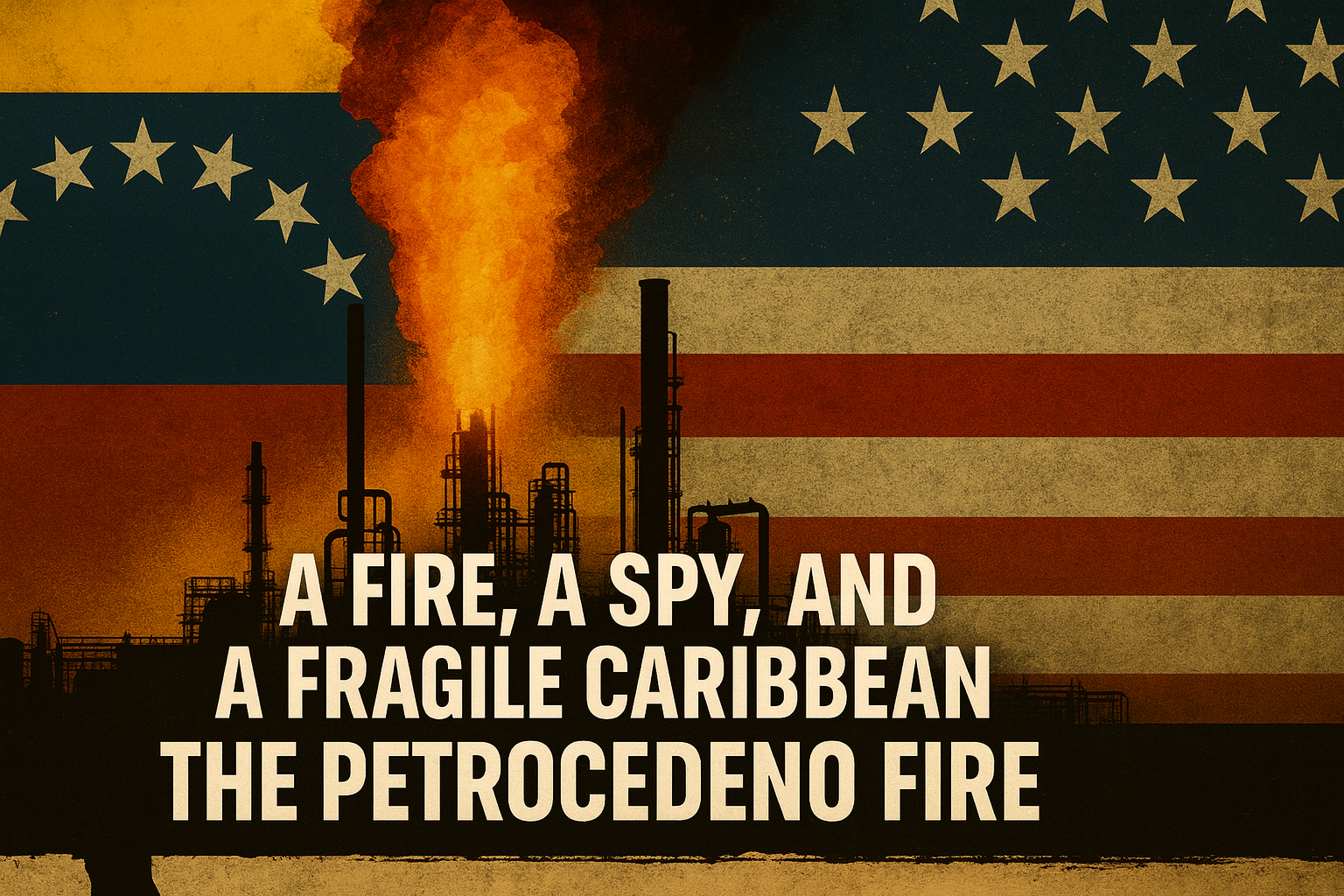
An explosion tore through one of the country’s most important crude upgraders, sending flames licking the sky above the Orinoco Belt. Workers were evacuated, videos leaked, and PDVSA released its usual vague, suspiciously calm statement about having everything “under control.”
But the tinderbox really ignited days earlier, when a senior U.S. official quietly admitted something Washington normally avoids saying out loud: there may be CIA operatives active inside Venezuela.
Put the two together — a major Venezuelan oil facility suddenly burning, plus the world’s most famous intelligence agency popping up in press briefings like an uninvited Carnival guest — and suddenly the Caribbean is staring at a geopolitical thriller it never bought tickets for.
The region is watching a petro-state catch fire literally while a superpower hints it’s moving pieces on the board quietly.
And for small Caribbean economies that depend on foreign fuel flows and stable energy prices, that kind of theatre is not entertainment — it’s a warning flare.
What Petrocedeno Really Is — And Why This Fire Matters
To understand the stakes, you first need to know what Petrocedeno actually does.
It’s not a casual refinery. It’s an upgrader — a facility designed to turn Venezuela’s ultra-heavy, near-tar crude into something light enough to export. In other words, Petrocedeno is one of the lungs of what remains of Venezuela’s oil industry.
When a lung catches fire, the whole body goes into distress.
And Venezuela’s energy body has already been limping.
Years of sanctions, collapsing infrastructure, fleeing foreign partners, chronic under-investment, and a refinery system one electrical spark away from a meltdown have left PDVSA struggling to keep anything running consistently.
So when the Petrocedeno fire erupted, this wasn’t a random flame. This was a blow to an already weakened system, at a moment when global eyes are pointed directly at Caracas.
“If your economy depends on an upgrader and the upgrader depends on prayer, a fire isn’t an incident — it’s a diagnosis.”
And then… the CIA whispers dropped.
A Spy Rumour Meets a Burning Facility — Coincidence or Caribbean Headache?
U.S. officials didn’t openly say “Yes, the CIA is running around inside Venezuela,” but they said enough. Enough for analysts to raise eyebrows, enough for Caracas to rehearse its usual accusations, and enough for the Caribbean to realise this situation is far from normal.
For a region already neck-deep in imported fuel, LNG contracts, rising electricity costs, and oil-price whiplash, the combination of the Petrocedeno fire and possible CIA activity creates a perfect geopolitical migraine.
Because when a petro-state is unstable, every Caribbean gas station becomes a hostage to events happening hundreds of miles away.
“When Venezuela burns and the CIA blinks, the Caribbean feels the heat — at the pump, in the budget, and in the cabinet room.”
This is not conspiracy.
This is not insinuation.
This is the uncomfortable reality of living next to a country whose oil sector is fragile — and whose politics are radioactive.
Whether the CIA is gathering information, monitoring actors, or just “observing,” their presence signals that Washington believes something important is unfolding.
See our article about the CIA in Venezuela here.
And when Washington is watching, the Caribbean is never far from the fallout.
Caribbean Energy: A House Built on Shifting Sand
You’d think the Caribbean would learn by now.
We’ve relied on Venezuela through PetroCaribe.
We’ve relied on the U.S. to stabilise prices.
We’ve relied on global markets to not go mad.
And somehow, every time, we end up shocked when things go sideways.
The Petrocedeno fire is not “just Venezuela’s problem.”
It’s a reminder of how fragile regional energy security really is.
The Caribbean doesn’t produce enough oil.
Most countries don’t refine their own fuel.
Everybody imports something from somebody — and that somebody is often juggling sanctions, espionage, blackouts, political turmoil, or leaking pipelines.
This fire is a mirror held up to the region:
How much longer can we pretend our energy future is steady when our main suppliers are locked in shadow wars and industrial breakdowns?
“Caribbean energy planning sometimes feels like betting your mortgage on two men fighting in a burning house.”
The Blaze as a Warning to Caribbean Leaders
Here’s the uncomfortable truth:
Whether the Petrocedeno fire was:
- an accident,
- a maintenance failure,
- a symptom of PDVSA’s decay,
- or something more complicated happening in the shadows…
…the outcome is the same.
The Caribbean is once again reminded that its energy security is built on the stability of nations far larger, far louder, and far more dangerous than ours.
And when the CIA gets mentioned in the same breath as an oil facility that just exploded, Caribbean leaders shouldn’t be shrugging.
They should be building diversification plans, strengthening renewable infrastructure, cutting waste, tightening emergency reserves, and acting like the future is already unstable — because it is.
Venezuela is burning.
U.S. operatives may be on the ground.
Prices can change with a single misstep.
Caribbean governments should treat the Petrocedeno fire as the region’s final warning:
Rely on nobody.
Plan for everything.
And stop pretending stability will magically appear out of geopolitical smoke.
This story is part of our wider Caribbean Geopolitics & Global Affairs coverage. Explore the full hub for regional security updates, diplomacy, migration, energy politics, and deeper analysis of how global power plays shape Caribbean realities.