Maduro Is Gone. The Regime Is Not
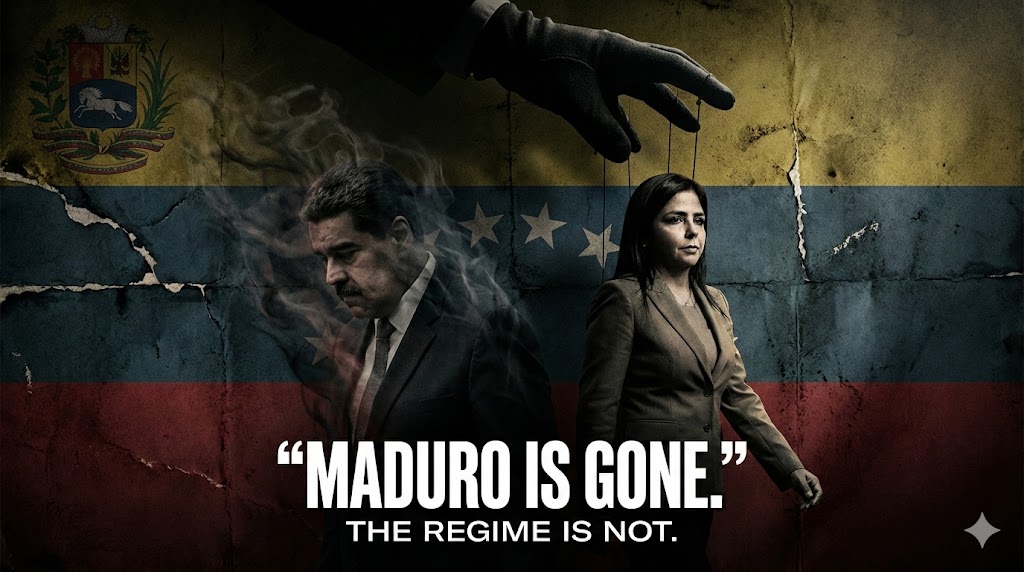
For a brief moment, the world thought Venezuela had crossed the finish line.
Nicolás Maduro removed.
Television panels buzzing.
Group chats firing off premature “freedom” memes.
But by the time the champagne corks were halfway out, Caracas had already answered the question no one wanted to ask:
If Maduro is gone… why does Venezuela feel exactly the same?
Because what disappeared was a man.
What remained was a system.
And systems don’t collapse just because you remove the face on the billboard.
The Arrest That Looked Like Regime Change
Let’s be clear: Maduro’s removal is not small news. It matters. The charges against him—ranging from narco-terrorism to conspiracy tied to international drug trafficking—were designed to do one thing above all else: turn a head of state into a criminal defendant.
That move shattered the illusion of permanence around his rule. Dictators thrive on inevitability. Once that spell is broken, everything shakes.
But here’s the uncomfortable truth: indictments don’t run countries. Institutions do.
And Venezuela’s institutions never left the room.
Enter Delcy Rodríguez: Continuity, Not Transition
Within hours, Delcy Rodríguez was sworn in.
Not as a revolutionary.
Not as a bridge to elections.
But as the most reliable thing authoritarian systems know how to produce: a continuity manager.
Delcy isn’t a break from Maduro. She is Maduroism with a steadier voice and cleaner optics. She knows the courts. She knows the military. She knows where the oil money flows and who keeps the lights on.
This wasn’t a handover.
It was a firmware update.
Same operating system. Same power structure. New splash screen.
Why Removing a Leader Is Not Removing a Regime
Here’s the part international headlines keep skipping.
A regime is not one person. It is a web:
- military command structures,
- intelligence services,
- loyal courts,
- state-controlled revenue,
- and a political elite with more to lose from change than from sanctions.
Maduro’s capture removed a node.
The network stayed online.
True regime change requires fractures—inside the military, inside the judiciary, inside the ruling coalition itself. None of that has happened yet.
What Venezuela experienced was decapitation without dismantling.
Trump, Machado, and the Uncomfortable Signal
Then came the line that should have made everyone pause.
Former U.S. President Donald Trump publicly dismissed opposition leader María Corina Machado, saying she lacks the respect and authority needed to govern.
That wasn’t just commentary.
It was a signal.
In geopolitical language, it suggested this:
Washington may not be betting on the opposition to actually run Venezuela.
Popular legitimacy is one thing.
Command legitimacy—the kind backed by guns, courts, and money—is another.
And right now, those levers remain firmly in regime hands.
What Real Regime Change Would Actually Look Like
If Venezuela were genuinely transitioning, you would see at least three things immediately:
First, the military would split, not salute.
Second, the courts would stop rubber-stamping continuity.
Third, control over oil revenues would move out of regime-aligned hands.
None of that has occurred.
Instead, the message from Caracas is simple:
Maduro was removable. The system was not.
The Caribbean Should Pay Attention
For the Caribbean, this matters more than most people admit.
Venezuela is not just a neighbour. It’s an energy supplier, a migration pressure point, and a geopolitical bargaining chip in a world where great powers are increasingly comfortable with managed instability.
A Venezuela that looks changed but functions the same is not liberation.
It is rebranding.
And history shows that rebranded regimes often last longer than the originals.
The Bottom Line
Maduro’s removal feels dramatic because we are trained to believe history turns on individuals.
But history usually turns on who controls the institutions when the individual falls.
Right now, those institutions are still speaking the same language, answering to the same networks, and protecting the same interests.
So yes—Maduro is gone.
But until the system that produced him is dismantled, the regime is very much alive.